- Details
- Hits: 178
9th October 2026
The ABBA Museum in Stockholm celebrates the 50th anniversary of this iconic song.

Who doesn’t love the songs of ABBA, and in particular Dancing Queen released in 1976. The contrast of innocent yet seductive verses and the dynamic soaring chorus driven to stellar heights by the pure voices of Agnetha Fältskog and Anni-Frid “Frida” Lyngstad evokes blissful memories of first dances, first loves, and the carefree excitement of boogying under the disco lights.
When Benny Andersson played the backing track of Dancing Queen, its working title Boogaloo, to Frida she was so moved that she burst into tears. She later said, “I knew it was absolutely the best song ABBA had ever done.”
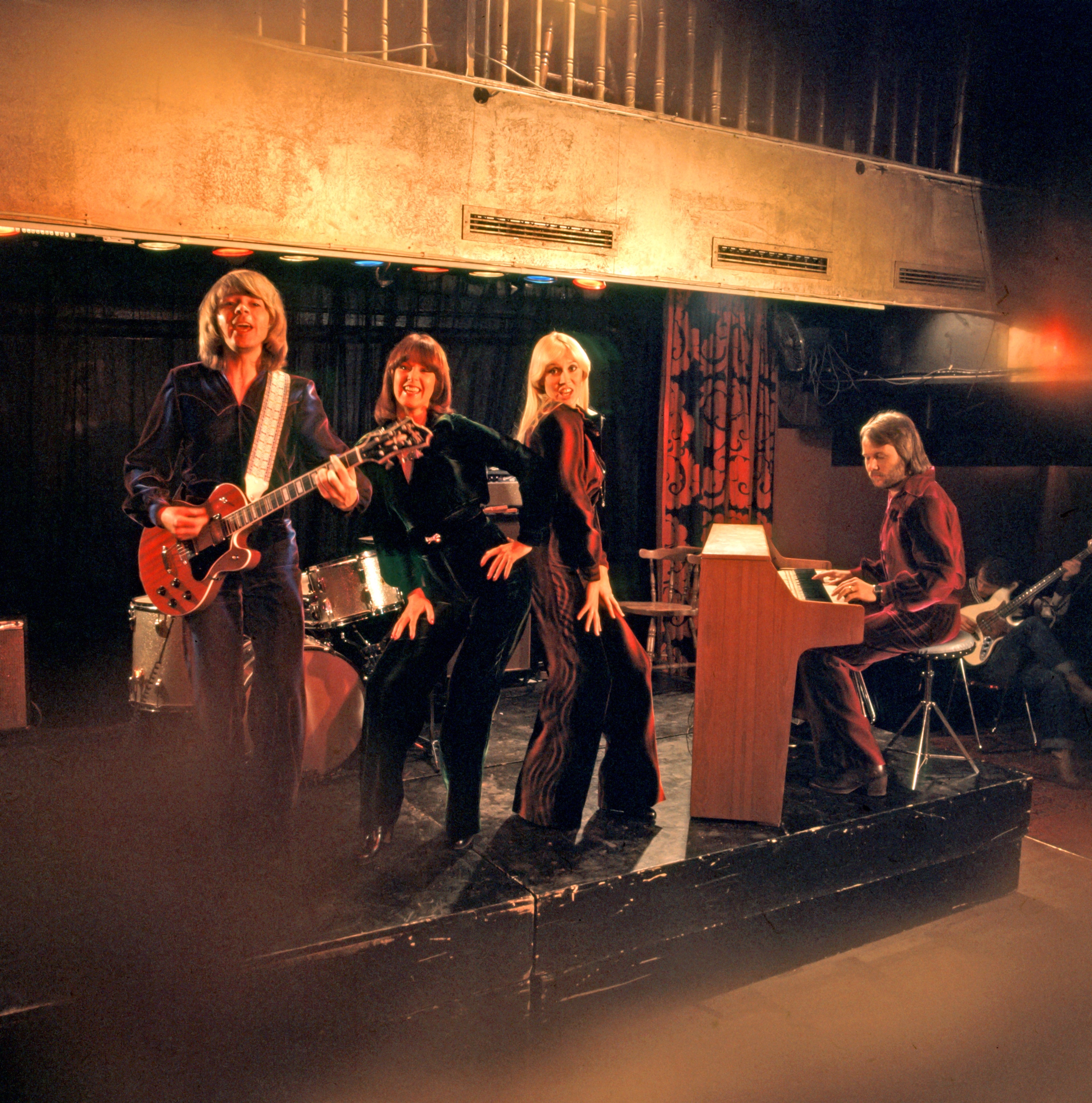 Composed by Benny, his songwriter partner Björn Ulvaeus, and their manager Stig Anderson, the song’s sophisticated piano lines and melodies were strongly influenced by the 1970’s American disco craze and borrowed influences from the US producer Phil Spector’s layered “wall of sound” musical arrangements. Not surprisingly, it reached the top of the Billboard charts becoming ABBA’s only number one in America, and was inducted into the Grammy Hall of Fame in 2015. Dancing Queen hit the top spot in the UK, as well as fifteen other countries.
ABBA premiered Dancing Queen on June 18th, 1976 at the Royal Swedish Opera House Gala to celebrate the wedding of King Carl Gustaf XVI to Silvia Sommerlath the following day. It was the first wedding of a ruling monarch in Sweden since 1797, so required a special song. The Swedish royals were not the only ones to appreciate it, apparently it was a favourite of Princess Diana. Frida reprised a semi-acapella version for Queen Silvia’s 50th birthday celebrations in 1993.
In the UK, their manager released the folky Fernando to follow up Mamma Mia, holding Dancing Queen back until late summer of 1976. It has since been streamed 275 million times in combined audio and video streams, and racked up 2.5 million singles sales and 260,000 downloads (Official Charts Company). In April 2024 BBC Radio 2 listeners voted it their ultimate ABBA song, with tens of thousands of votes cast by fans. 
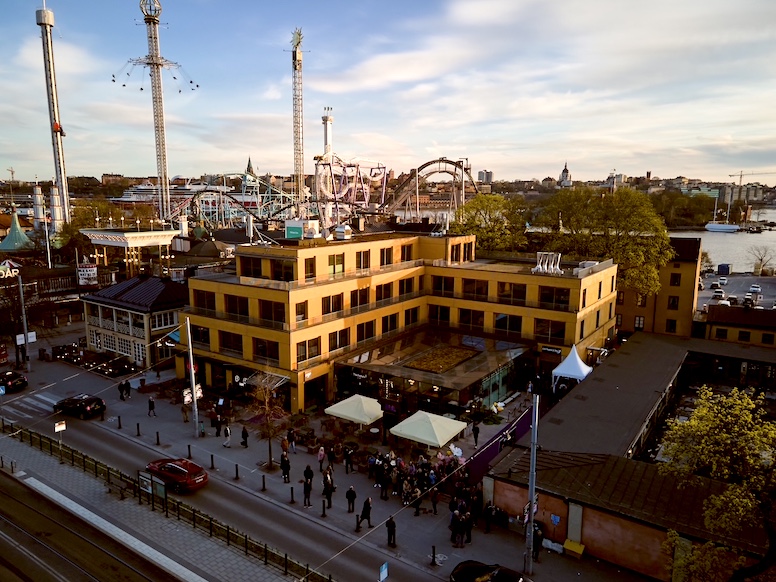
On October 11th, 2026 the ABBA Museum in Stockholm celebrates Dancing Queen’s 50th anniversary with a special exhibition. Housed in the basement of the Pop House headquarters, the museum first opened in 2013. Pop House is the music investments company founded by Bjorn Ulvaeus to operate virtual Avatar concerts, for example ABBA Voyage at a purpose built arena in Queen Elizabeth Olympic Park in London where the band appears to be physically present as their avatars perform with a live 10-piece band.
ABBA split in 1982 with the girls pursuing successful solo careers and the boys continuing their songwriting partnership. The avatars were created so audiences could see them perform their greatest hits as they looked and sounded in their prime. The projections are not holograms, but rather 2D digital projections rendered from 3D digital models created with motion capture technology, and advanced CGI animation developed alongside George Lucas’s (Star Wars, Indiana Jones) special effects company Industrial Light & Magic.
The band reformed for five weeks in Stockholm in 2020 under the gaze of 160 cameras wearing full body motion capture jumpsuits and helmets embellished with reflective markers to capture every body movement, facial expression and gesture. Recordings, photos and videos from the 1970’s made up the rest of the data.
Downstairs in th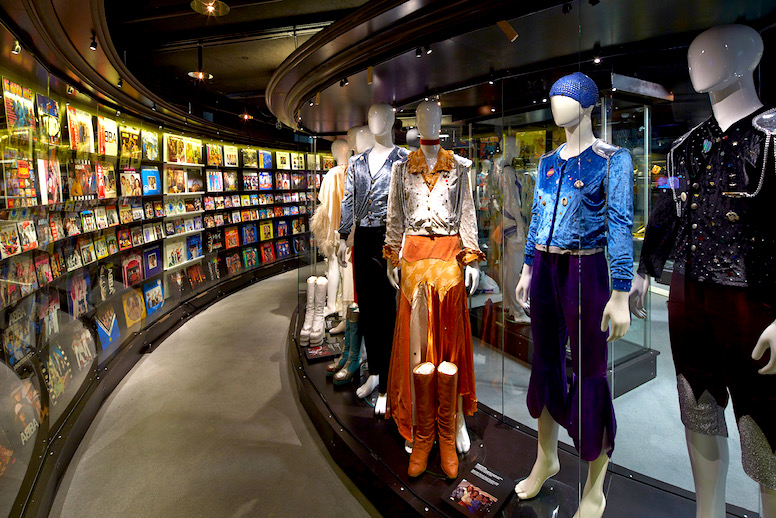 e museum there’s an opportunity to perform with the “ABBAtars,” as the band prefers to call their digital doppelgängers. My performance of Mamma Mia, although greeted with enthusiastic applause and wows from the small audience of parents and kids, only proved how difficult co-ordinating song and dance really is, and renewed my respect for live performers.
Aside from technical innovations, this dedicated collection provides a fun and informative display exploring a rich seam of traditional archive material tracing the timelines of each band member, born in the mid-1940’s, with the exception of Agnetha, born in 1950, and the diverse musical paths leading them to each other.
Despite receiving “nil points” from the British judges, ABBA’s triumph at the 1974 Eurovision Song Contest with Waterloo immediately garnered international success. They would later receive The Special International Ivor Novello Award from the British Academy of Songwriters, Composers and Authors.
 The museum walls lined with innumerable gold discs represent subsequent sales of 150 million records worldwide. And, the presence of many original and remade sumptuous stage costumes are a reminder not only of wonderful songs and performances, but also of the svelte physiques of all four band members.
The word museum from the Greek for muse is a good fit for the combined legacy of Agnetha, Björn, Benny and Anni-Frid aka ABBA, and a fitting tribute to a band from a non-English speaking country which inspired listeners worldwide, and to the music that lives on, evolving and bestowing new meanings to new generations.
Dancing Queen is the finale of ABBA’s Voyage and remains a source of unfiltered joy and happiness, filling dance floors to this day. Agnetha recalls, "I found the song so beautiful. It's one of those songs that goes straight to your heart. It's often difficult to know what will be a hit. The exception was Dancing Queen, we all knew it was going to be massive.”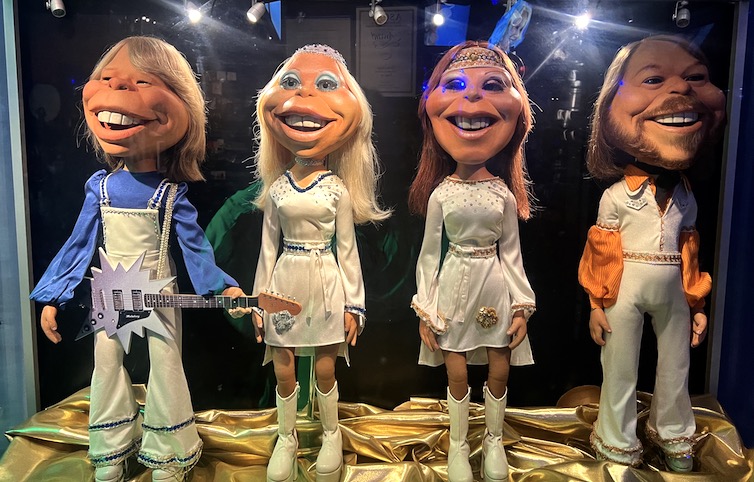
50 Years of ‘Dancing Queen’ exhibition
Pophouse Exhibitions & Abba The Museum
The exhibition opens at ABBA The Museum in Stockholm on October 11th 2026.
- Details
- Hits: 57
October 2026\
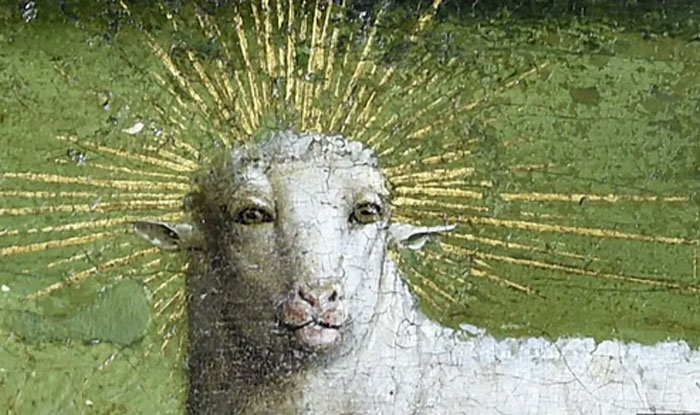
Image supplied by Claire Palmer
Who can witness the joy of being alive
And yet bring that life to a sudden end?
Surely that joy, as seen in a lamb
cavorting in the fields of early Spring,
deserves to know a living Summer day?
Merits the chance of enjoying the bliss
of resting cosy and content on mother’s outstretched legs
pressing close against her loving chest?
How can it be right to end a joyful life
for a few soon eaten and forgotten meals?
The avid meat eater makes a quick response:
“Well look at the way things go in Nature.”
(Alas, for carnivores there is no other way).
But we are omnivores, not carnivores,
so for us there is another way.
How shocking that he who cared for mother
is the one who steers her son up the ramp
of the truck that takes him to his end!

The mother cannot believe her lamb has gone and calls
and searches the field so many, many, times,
quickly passing over retained ewe lambs.
For days, for weeks, she stands, ears pricked forward
listening for his youthful answering call.
But that call is a call that never comes.

Why cannot we be satisfied with a yearly crop of wool?
A fabric as gentle as that loving mother’s soul.
And leave the lambs to clip the grass with delicate lips,
manuring the earth as they pass, and treading flat the pastures,
bruised by cattle, with their lightweight golden hooves.
So that we never have again to look into those sad dark eyes
where dwell the tortured fragments of a grieving heart.

Adam Dowell 2025.
- Details
- Hits: 216
September 2026
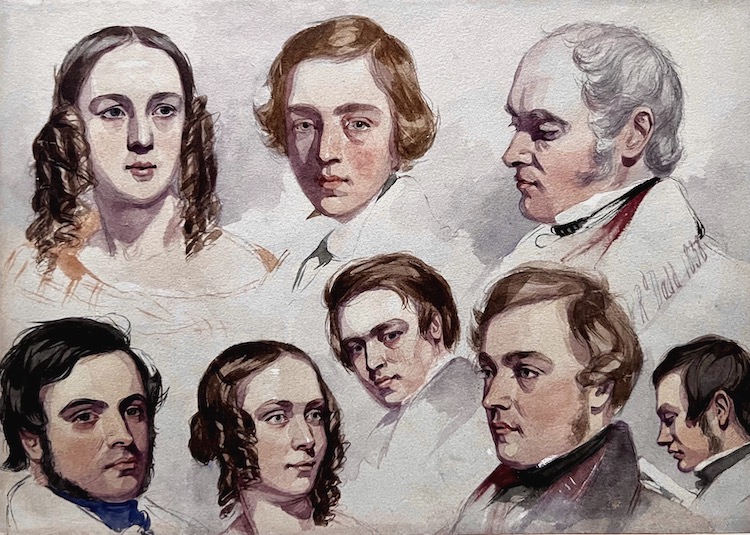 The Richard Dadd exhibition at the Royal Academy (RA) is in turn enchanting and disturbing. He was a Victorian painter of extraordinary fairy worlds of legend and literature, as well as portraits and watercolours inspired by his travels around the Middle East and the Mediterranean.
Dadd’s early portrait of fellow student Augustus Egg dressed as a Puritan soldier in a tall conical hat has all the hallmarks of a great artist. Dadd and Egg were members of The Clique, a circle of young painters enrolled at the RA in the late 1830s. Dadd, as its leader, distinguished himself by winning medals for Life Drawing, Drawing, and Painting, establishing a reputation for exceptional technical craftsmanship.
The Clique predates another influential RA group The Pre-Raphaelites, by some ten years. Whilst Rossetti, Millais and Holman Hunt frequently painted scenes from antiquity and directly from the real world, Dadd’s delightful and incredibly imaginative oil paintings are drawn from several of Shakespeare’s plays, A Midsummer Night’s Dream in particular.
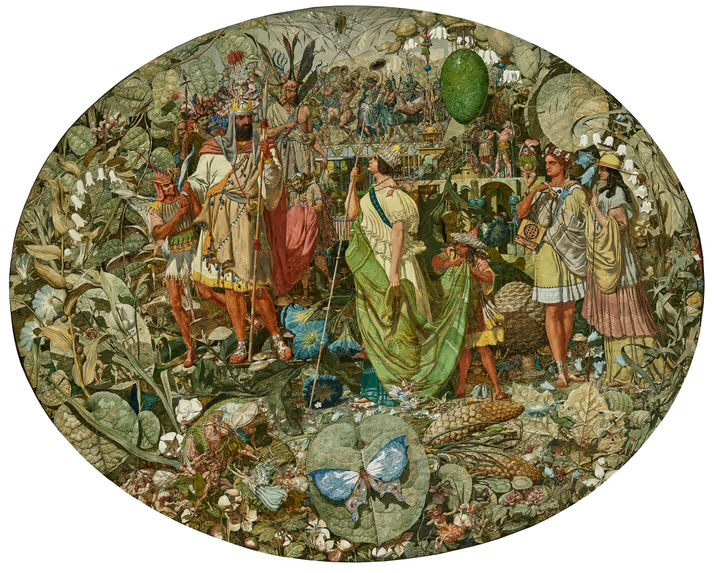 Ethereal portraits of Puck (1841),Titania Sleeping (1841) and the fairy worlds inhabited in Contradiction: Oberon and Titania (1845-1858) reflect Dadd’s formidable skills in depicting lively groups of minute fantasy figures in microscopic environments or circle dancing under the moonlight.
The ferocious detail in the Fairy Feller’s Master-Stroke, (1855-64) alongside the three strange heads in Bacchanalian Scene (1862) imbibing a strange brew from a golden cup is overlaid by delicate twists of bindweed, curls of ferns and wheat sheaves that transport the viewer to entirely different times and places.
This beguiling minutiae of fairy worlds, watercolour landscapes and frankly exotic colours of peopled scenes remembered from his travels create a heady mix. But the dreamy intoxication is abruptly ruptured by the shocking revelation that Dadd brutally murdered his own father. (Pictured above top right)
At first Dadd wrote lucidly from abroad, but his mood changed and he developed a severe form of psychosis following a rushed visit to Egypt and Syria. After returning to the family home and stabbing his father in Cobham Park in Surrey in1843, he went on the run to France. There he was restrained by passengers on a stagecoach southeast of Paris after he slashed the throat of a fellow passenger with a razor. When the gendarmes arrested him they found a hit list of potential victims in his pocket, which included Ferdinand I, the Emperor of Austria. 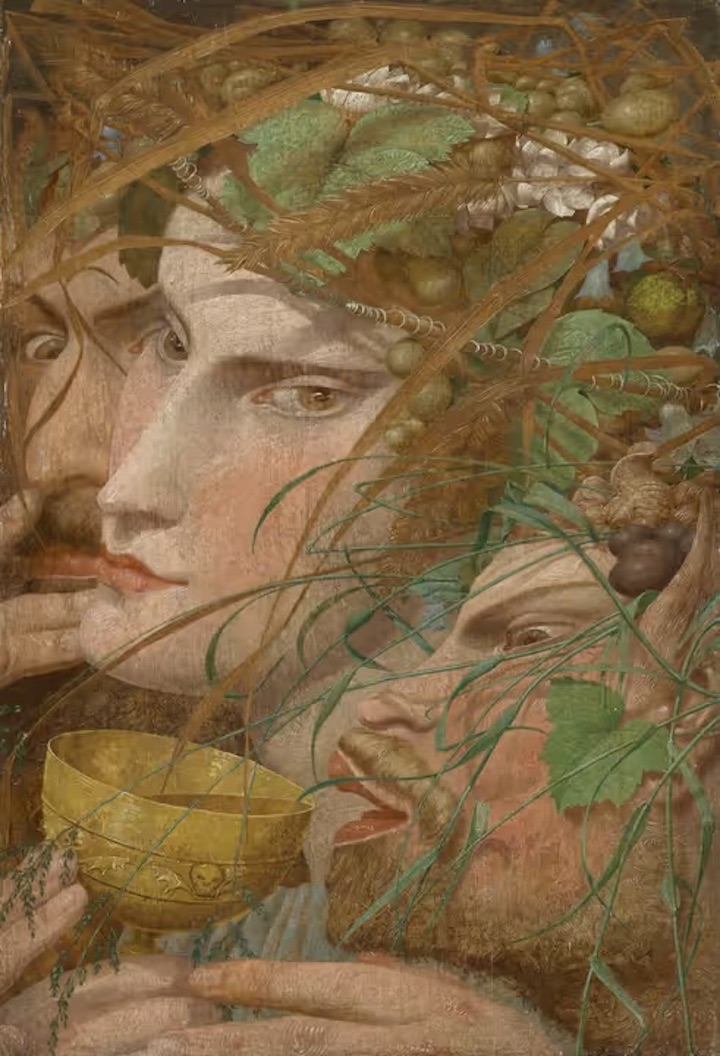
When the French deported him back to England he was Incarcerated in the madhouse in Bromley known as Bedlam or Bethlem Hospital without trial and later transferred to the high security prison Broadmoor in Berkshire. In both institutions he was encouraged to explore his creativity with a surprising amount of freedom.
A significant figure in Dadd's rehabilitation was Dr William Hood, who became the physician superintendent of Bedlam at the age of 28. He reformed the care of insane patients by removing mechanical restraints and dungeon like wards and providing books and art materials. He commissioned pieces and collected Dadd’s completed artworks, including Portrait of a Young Man (1853) depicting a serene Dr Hood in his garden.
A panoply of musicians, writers and painters inspired by Dadd’s ouvre include Freddie Mercury, who wrote the song The Fairy Feller’s Master-Stroke for the album Queen II. Neil Gaiman’s position paper explores the painting’s magnitude in depth, and Terry Pratchett cites it as an inspiration for a chapter in his popular Discworld series. John Everett Millais pays homage to both Shakespeare and Dadd in the otherworldly forms and intense foliage surrounding Ferdinand Lured by Ariel (1849-50), in a scene from The Tempest.
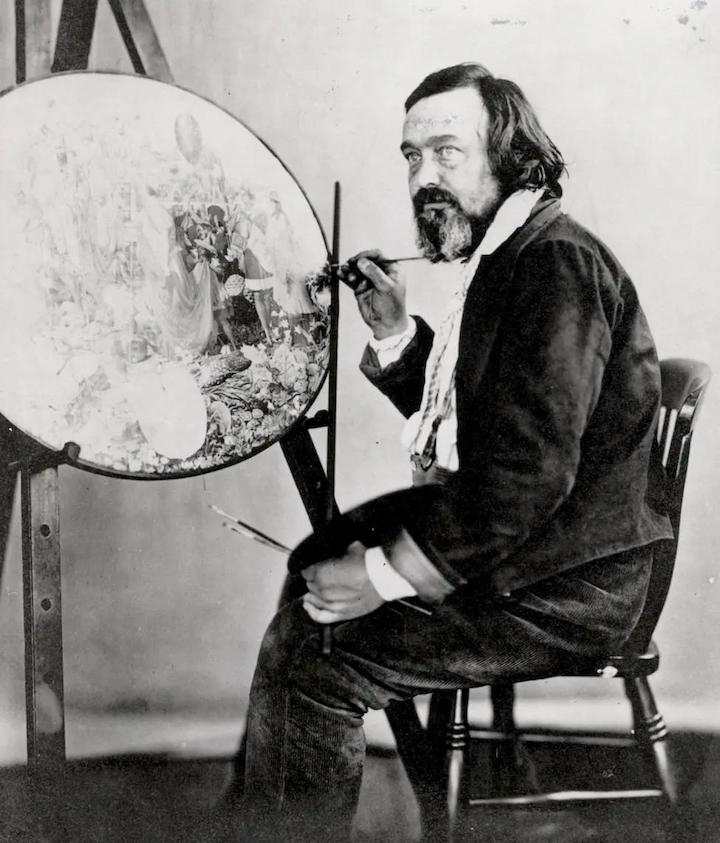 It is strange to think of an artist so brilliant also being capable, but not culpable for foul deeds. In a fascinating retrospective the RA has unashamedly and compassionately claimed this genius as one of its own.
Richard Dadd Beyond Bedlam runs at the RA until 25th October 2026.
Richard Dadd, Contradiction. Oberon and Titania, 1854-58. Oil on canvas, 61 x 75.5 cm. Private
Richard Dadd, Bacchanalian Scene, 1862. Oil on wood, 35.6 x 24.1 cm. Tate:
- Details
- Hits: 144
September 2026 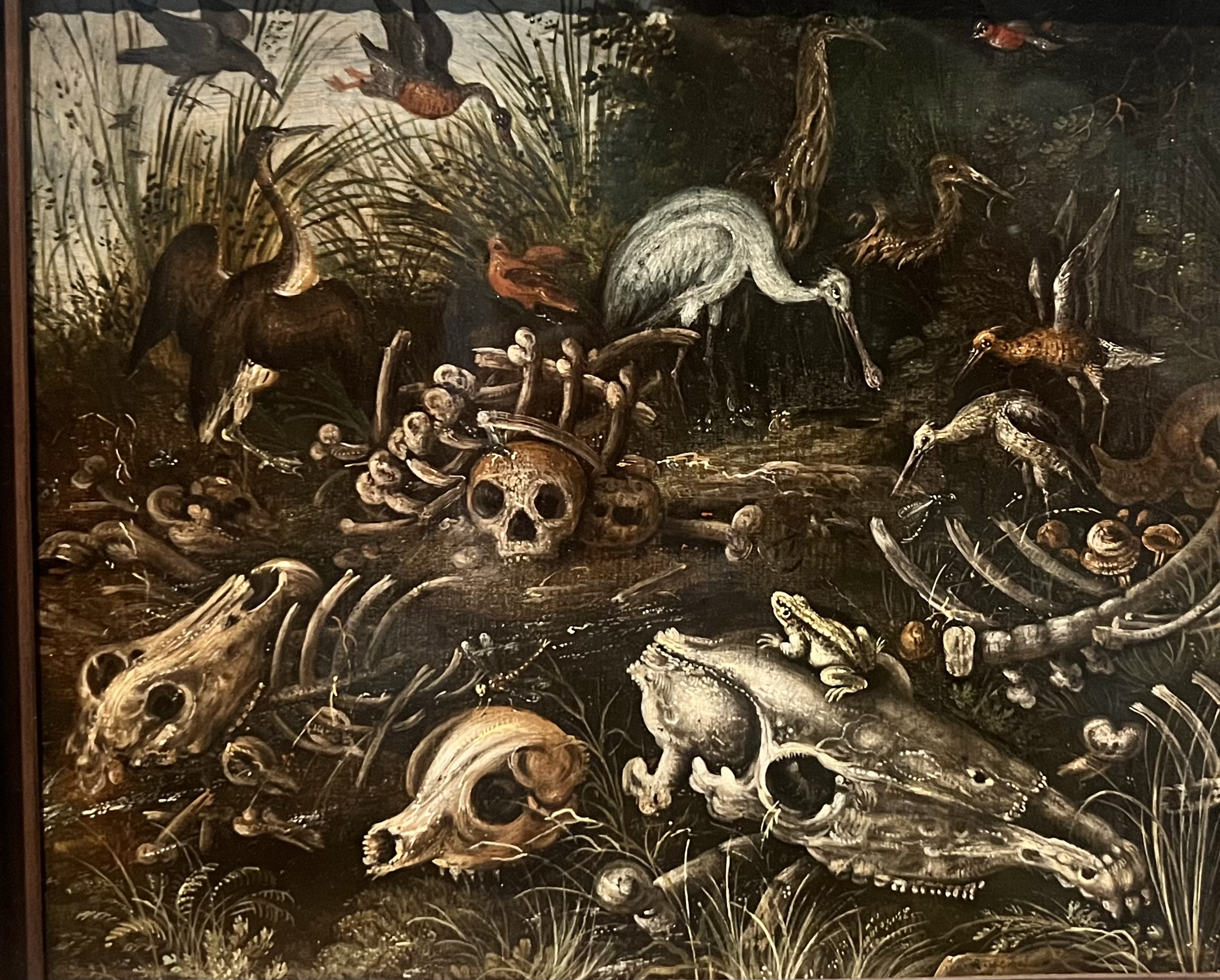
There are grass marks on my skin. The garden connects me to my senses in safety. Where do I begin?
A frog lands on my cushion and a butterfly in my ear. The frog is yellow, green and black. One gold-lined eye watches me, his other eye is shy and winks a wicked wink. Perhaps he’s a wicked prince looking to grab a kiss with his four short fingers and one long thumb. His bulging throat is a pinkish speckled stone.
All around us apples are decaying on the ground. Wasps patrol the rotten fruit and I could easily put my bare feet down and be stung. In the garden where chives and chicory thrive, oregano bolts and brambles writhe.
I’ve become the humming of bees and the breeze stirring the sun-suckled grass. An old fashioned sash splutters and rushes up as someone opens a window.
Bees and hoverflies are friends of mine and deep down in the garden no pesticides I ply, despite the snails, slugs and greenfly.
I lie supine and think of you in your woodland willow coffin. You turn your skull-face to me, and whisper, “Terra, protect the Earth.”
In the garden the ash, fig and cherry leaves glow differently under this Harvest Moon. September always comes too quickly.
- Details
- Hits: 195
12th August 2026
I travelled to Sicily several times between 2009 and 2016. Each time I was compelled to write not just about its remarkable scenery and history, but about my observations, thoughts and feelings.

Do you know the land where lemon blossom grows?
Amid dark leaves the golden orange glows.
A gentle breeze drifts down from the blue sky,
still stands the myrtle, and the laurel high.
Might you know it?
There, there
Would I with you, oh my beloved, go.
These words from Goethe's 1796 novel Wilhelm Meister's Apprenticeship reflect his attraction to the Mediterranean World. I didn't know until after my visits to Sicily that I shared a soul journey with Goethe, which was a fresh source of inspiration demanding a further exploration of my time on the island.
Acireale
 Waiting for the bus to leave Catania Central station I shed my clothing down to a t-shirt and roll up my jeans to just below my knees in response to the midday sun. Suddenly I’m struck by the fact that I started solo travelling aged 14. Nowhere as captivating as Sicily, certainly but a journey taken with the single-minded purpose of reaching an unfamiliar destination. I’m older now, but the spirit of adventure is ageless.
The driver indicates he is ready to depart by saying, “Ok lady.” I climb onboard after unrolling my jeans and choose a seat close behind him. Although curious and excited, I’m also nervous about relying on the goodwill of strangers. Because I have discovered my phone is not working on Italian networks, so I can neither phone or text my host Gloria for directions.
A Franciscan nun sits down next to me. Her billowing habit is made of stiff, grey buckram impervious to all stains and weathers, it spills out from her onto my seat. I settle down, we are going all the way to Acireale together, some 10km north of the Sicily’s second largest city.
My printed off Airbnb map indicates only a couple of street names next to a vast expanse of blue sea. I ask the nun if she knows Via Pacino. She shakes her head and shows the bus driver my map. He calls cheerily out of his window to people on the street, “Casa Gloria?” His enquiry is met with shrugs and smiles. Keen to help he calls the mobile number printed on the sheet and Gloria answers. She is shopping in Catania about fifty minutes away, frustratingly where we have just come from.
I say my farewells to the nun and to the driver and alight in the centre of Acireale. I drink a small intense coffee in a tiny white cup and call Gloria from the cafe owner’s wife’s phone. She gives me a set of directions which cannot be verified by others in the cafe. I gather what I hope is a more coherent set from an intelligent young man, who concludes his step by step guide with an, “Enjoy your journey.” And so I do at first, wandering through little parks and squares passing domed churches and the fish market cleaning down for the day.
On the long road that I hope is leading to Via Pacino I spot a good black and white stencil of Sid Vicious spray-painted on the wall. I take a photo and send it back to London to see if my phone is working on UK networks. Following the prescribed sequence of streets has not led to my destination. I see a garage sprawling down a side street, so I speak with one of the mechanics there. We communicate perfectly, despite my not speaking any Sicilian or him any English. He phones Gloria and they have a good old chat after which he assures me she will pick me up in ten minutes.
Shortly a car pulls up, I hope it’s Gloria. But as soon as I approach the woman waves me away. Minutes later she enthusiastically greets a friend and hands her something in a decorated box. I feel rejected and alone, shifting my position to the opposite side of the street. An ice cream van arrives in the pelting afternoon heat and parks on the corner. A shrill whistle blows repeatedly to announce its presence as a few people come down from the apartments around the garage and queue for a gelato.
 From my new vantage point I decide not to want or crave sugar, rationalising that I have only just arrived and need to pace my eating. The ice cream eaters stare at me piteously as I sit sweltering on the opposite kerb. A negative voice goes off in my head, the voice of ancient fear and trauma. Can I make it through the next few minutes of palpitations and paranoia; the stubborn residue of separation, self-denial and resistance?
The negative voice gets louder and protests dispassionately, “It’s her time.” Then it debates whether ‘it’s her time’ in terms of my allotted time on planet Earth, or it’s my time to do whatever I want, even if it’s losing my mind on a street somewhere in Sicily. As the universe spirals in, I flip a homeopathic bee remedy under my tongue and take a swig from a bottle of medicinal herbs, vervain, skullcap and the like. I have to physically move around or expire right there - my choice.
Back on the main road leading nowhere, I stop running and turn to face myself. It really would be madness to miss the connection with my host. With a nagging sense of doom I retrace my steps to the garage. The mechanic is waving, and as I wave back Gloria thunders up the road in her navy blue Subaru. “You are alone?” she says in greeting. I like her immediately, and when she suggests going for something to eat and drink I gladly accept. It couldn’t feel more different, laughing and enjoying my first almond granite. She takes hers with a brioche, I’m still mindful of the calories.
- Details
- Hits: 156
August 4th 2026
I travelled to Sicily several times between 2009 and 2016. Each time I was compelled to write not just about its remarkable scenery and history, but about my observations, thoughts and feelings. .
Palermo
 Palermo is wild and rocking on a Thursday night and imbued with the sound of the 1960’s. The Beatles, The Doors, and Bob Dylan’s harmonica blares out, interspersed with hypnotic Arabic music. I feel alive and surprised to be alive walking on the wide cobbles of the medieval alleyways shining with wear.
Young Sicilians crowding the narrow streets part ways ever so slightly until I ramp up my aura, only then do they make a little more room for the old souls passing through. But it’s relaxed, all out in the open, out on the streets. It’s a dreamscape populated by motorcycle boys and girls who drink and smoke to get by.
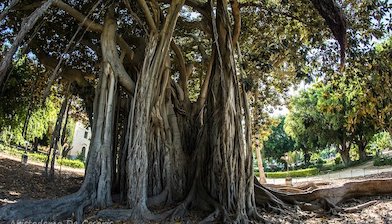
Stinking rubbish is piling up in the labyrinthine passages. Like many old cities Palermo operates on a base, low vibration. The idea that it might be a place to drop acid and be subsumed by it all arises. And, in Garibaldi’s Garden, in Parco d’Orleons with the sad caged birds, and in scorched grass squares magnificent Banyans purify the senses. 
In a pizza parlour on a street full of pizza parlours, feeling slightly tipsy and addicted to sugar, I ask the cafe owner for a gelato. I wait patiently as she communicates with unknown hand gestures. She’s busy making good money and smokes far too much, but her health is protected for now.
My first floor lodgings are rudimentary. Tiny blue tiles dotted about the kitchenette with two cooking rings and a coffee pot brighten the room. The mattress is flea bitten and the host’s abstract paintings and loose weavings are for sale on cob walls. From the balcony I see her laughing and chatting on her way to the bank. The bathroom window looks onto the wonky balconies of buildings underpinned with wooden pegs reminiscent of those holding up the Ponte Vecchio, only smaller.
 Later in bed the wooden shutters are making complex patterns on the ceiling. Palermo is a place of shadows. There is a glorious decrepitude here. In parts it's not unlike Rome, where municipal development has not spoiled the intrinsic beauty of the city. Cultures and identities are preserved mostly because the government can’t afford to develop, and widespread corruption means the money goes elsewhere.
The sounds of the night eventually simmer down. At dawn, the incessant car horns start blaring again: long streams of honks and short bursts of beeps at various frequencies. This unnatural horn chorus prevents any return to sleep. In between the honks is the rumble of a city that has lost its mind; simultaneously exciting, maddening and disturbing. A strident language of parps supplants normal conversation as the slaves to their cars communicate via horns.
Despite the cacophony it’s womblike and protected in my shuttered room and I arise to record the noise pollution. I consider the ease of my journey so far, the levels of anxiety have dropped and people are nice to me. At last the blast of car horns is lulling, moving further away, like a storm.
- Details
- Hits: 175
July 27th 2026
A handful of women involved in a poetry speaking competition at Oxford one hundred years ago had a significant influence on the future of speech and drama, as well as votes for women and equitable rights in the Arts.
By all accounts The Oxford Recitations (1923-29) held throughout the 1920’s was an exciting place for a young person to be. Elsie “Fogie” Fogarty, the pioneering vocal coach and founder of The Royal Central School of Speech and Drama believed that 1924 was the most exciting year of all, later writing, “It is difficult to describe those early days at Oxford. The place itself with its majestic gravity, tempered for space by the glow of youth in summer gaiety, such a jolly do!”
Fogie had answered the call of the future Poet Laureate John Masefield, “To find England’s most beautiful speakers,” by entering the cream of her students into his spoken word competition. Masefield, recovered from his war efforts, was enlisting the help of Oxford dons, fellow poets and playwrights to judge the speakers, who came from all over the world to recite the finest English poetry and plays, some especially written by the judges.
Diana Homer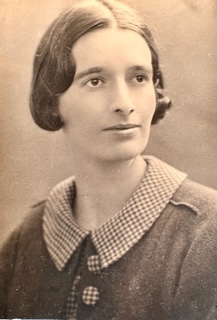 Inside his richly annotated copy of the 1925 Time Table, the war poet Laurence Binyon, best known for “For The Fallen (1914) marked my then 18 year old grandmother Diana Homer (left) as a favourite speaker, with a reminder to buy matches scrawled on the cover. His scoring of the women’s recitals reveals a close competition between Miss Diana Homer 89, Miss Margaret Rawlings 85, and Miss Ray Litvin 84 in the first round of the dramatic poetry class, Rawlings being the eventual winner. (More about these two women later).
After a long day of speeches the hopeful contestants flocked to the results board at The Schools on the High Street for the names of the winners of the individual classes posted every evening, Diana would have been excited to see, “Praised by all the Judges” written beside her name. Her voice had left quite an impression on the judge and future Poet Laureate John Masefield.
In his Manchester Guardian review of August 1st 1924, The Oxford Recitations: A New Feeling for Poetry, Masefield described Diana as a speaker of rare promise and rare achievement who attracted the judges whenever she spoke. “Had there been a consolation prize it would have gone (among the women) to Miss Homer,“ he wrote.
At the competition the following year, true to his word, Masefield awarded her with The Oxford Prize for The Best and Most Beautiful Individual Piece of Speech, presenting Diana with £200 in today’s money and a signed copy of his epic poem Reynard The Fox (1921).
In July 1926, the BBC sent out scouts to hear Masefield’s beautiful speakers for potential radio broadcasts. Diana’s winning recital, part of Milton’s Samson Agonistes was amongst one of first poems ever to be recorded for His Master’s Voice (HMV) catalogues of 75rpms. However, the Oxford Recitations speaker on the record was Fogie’s ‘star’ student Clifford Turner.
Diana Homer (1906-1941) was the provincial daughter of a Unitarian minster, a religion popular with poets, writers and scientists, for instance Sylvia Plath, Mary Wollstonecraft and Charles Darwin. Her grandfather Frederick Augustus founded a Band of Hope, and a Ragged School & Mission, and spoke against the Truck System which paid workers in tokens they could only spend in the company store instead of money wages, for which he was fined.
Her forefathers were once listed in Burke’s Peerage as landed gentry granted lands in Dorset in the 12th century. Several centuries later a family dual led to one branch of the family moving to the West Midlands. There, Squire Homer acquired the Tudor Bag End Farm (left) in the village of Dormston in Worcestershire, which had found its way into the hands of JRR Tolkien’s aunt Jane Neave by the 1920s.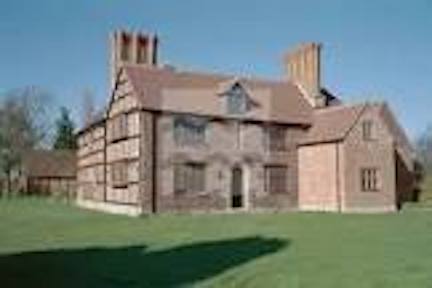
It was to Bag End the young Tolkien went to recuperate in 1923 after a long illness, and where he fell under the spell of the Worcestershire countryside. Tolkien, who later befriended John Masefield and recited at his Oxford Diversions, would also famously use Bag End meaning cul-de-sac or bottom of the bag for the name of Bilbo and Frodo’s home in The Hobbit and Lord of the Rings.
During those heady summers in the electrically charged atmosphere of Oxford Diana battled through days of elimination classes to reach the women’s class finals. Her greatest success came in 1928 when she won the coveted bronze medal for second place in the women’s Oxford Prize Class.This was the year the esteemed Scottish actor Alistair Sim, then a drama teacher at Edinburgh, won the Men’s Class 1 for his recital of a part of Chaucer’s The Nun’s Priest’s Tale.
Sadly, Diana died a young woman in 1941, so there is no knowing what else she might have done.
- Details
- Hits: 257
July 2026
Sam Burcher attends the National Portrait Gallery for the Herbert Smith Freehills Kramer Portrait Award 2026 for a close look at the finalists.
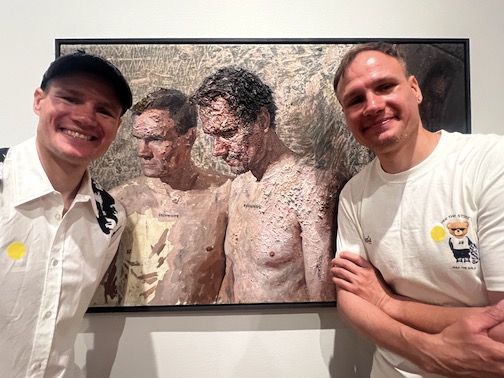 The launch of this exhibition at the NPG provides a unique opportunity not only to see a variety of great contemporary portraiture, but to meet many of the artists and sitters in front of their portraits.
For instance, there are the Gataveckas twins, Aligirdas and Remigijus from Lithuania, who naturally gravitated to making the double self portrait Genealogical Deformation (2025). I’m not sure which one of them told me “We’ve always done everything together, so why not painting.”
Their mischievousness and warmth in life is a sharp contrast with the patches of whitish metal on the canvas and prodigious layers of oil paint making blistering and bumpy flesh tones, evoking a sense of coldness and contagion.
There is the barefoot sitter or rather stander in the full length portrait Turning Thirteen (2025) by Frances Bell. Her daughter Flora is a shy, but captivating figure in the gallery dressed as she was in her portrait. One year later her hair is longer and her long pleated skirt is a darker shade of saffron under the artificial lights.
 Emily Rogers & Sight-Size
Ostensibly, I’m here to meet the young artist Emily Rogers 29, one of the 51 finalists. She was introduced to me by Fenella Lockyer, the founder of Portfolio London, a leading portrait commissions and bespoke fine art business representing Emily amongst a number of Britains most talented established and emerging fine artists.
Emily’s portrait Ellen was chosen from 1,474 entries from 63 countries, all competing for one of the biggest prizes in portraiture of £35,000, She confidently described her use of “sight-size” to paint her friend Ellen from life and to scale in natural light over six or seven sessions.
Sight-size is a measuring technique developed by the Old Masters who placed the canvas side by side with the sitter. The artist, in this case Emily, walks back to observe both from a distance, then walks forwards to make her marks, sometimes just one on each approach. She then walks back to the same spot to look again and walks forwards to make another mark, and so on, often covering many miles in one sitting.
Acquiring the skills to represent an accurate likeness of a subject has taken several centuries to develop and this evolutionary process continues at the Charles H. Cecil Studios founded in Florence in 1991 and housed in the city’s oldest Atelier where Emily completed her training in 2022. She returns to the Studios throughout the year to teach and maintain her portraiture practice.
Charles Cecil was taught by a pupil of the Florence born artist John Singer Sargent, who produced around 900 portraits, including the notorious Madame X (1884), The Blue Boy (1890) and Theodore Roosevelt (1903). One step further back is Sargent’s teacher the brilliant portraitist Carolas-Duran, the first winner of the gold medal at the Paris Salon in 1879. (Singer’s portrait of Carolas-Duran pictured below right). Going forwards, it’s Charles Cecil's mission to keep this lineage of master-pupil aliv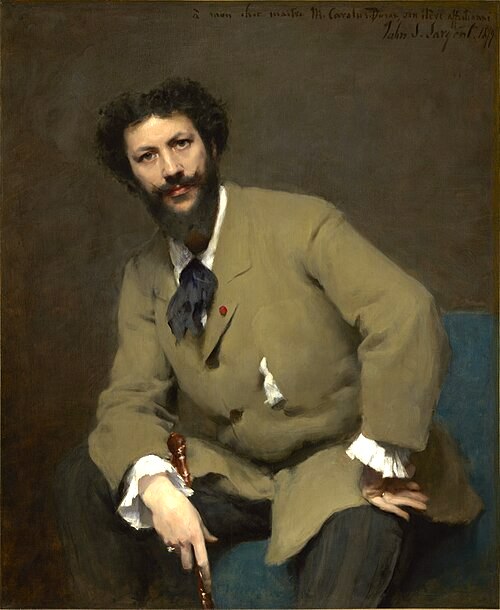 e into the future.
In its truest tradition dressing up remains an integral part of portraiture. And, it’s evident that Emily enjoyed painting Ellen, who was easily persuaded to swap her casual clothes for diaphanous fabrics, a cascading hair ribbon, a white bodice loosely laced and draped in pearls. The clever interplay of colour, light and shadow cocoons the sitters exquisite skin tones and expression.
Light and air emanates from Ellen’s violet background where the paint was kept thin in parts to allow the canvas to “breathe.” The variety of bold brush marks on the costume speak to me of the great portrait painters, with Emily citing Van Dyck and Velázquez as her influences. When mastery is combined with her fresh, fun feel, the image imparts an unshakeable faith in what a portrait actually is. Not just a fleeting moment of someone’s likeness, but a meticulous portrayal of their underlying character, or dare I say it, soul.
Portraiture is enjoying something of a renaissance, consider the popularity of television programmes such as Portrait Artist of The Year, on which Emily was seen painting the writer Richard Curtis in 2023. She also recently completed a wonderfully life-like portrait of King Charles III for an historic private members club in London, has exhibited at The Royal Society of Portrait Painters, and The Society of Women’s Artist 2024-2025 where she won the Karen Walker Young Artist award
- Details
- Hits: 432
29th April 2026
Sam Burcher visits the newly opened David Bowie Centre in London’s East End.
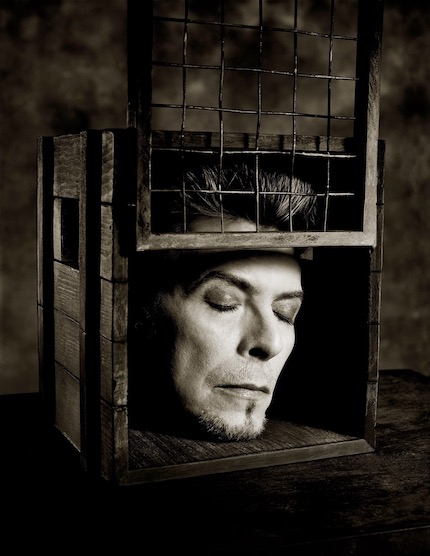 “My brain hurt like a warehouse, it had no room to spare. I had to cram so many things to store everything in there……”
These poignant lyrics are part of David Bowie’s song Five Years from his album Ziggy Stardust and The Spiders from Mars (1972) about a crumbling Earth with only five years left to spin.
Ten years after his death in 2016, the Victoria & Albert Museum has honoured the extraordinary legacy of this prolific singer-songwriter, artist, actor and multi-dimensional cultural chameleon. The David Bowie Centre within the V&A East Storehouse is a vast warehouse in east London, where some 90,000 items that he collected are permanently stored.
Of these, just 200 objects are displayed at any one time in large glass cases that reveal his creative personas, processes and projects. For example, the stunning ice blue suit he wore for the video, which contrasted with his shock of flame-coloured hair, the red leather Ziggy Stardust jacket with an electric blue lightning flash emblazoned across the back, a pair of gold-winged cowboy boots, and the lyrics of his rousing anthem written by hand in 1977.
The collaboration between Bowie and the V&A began with the exhibition David Bowie Is, the first museum retrospective of a major rock and roll star. To date, it’s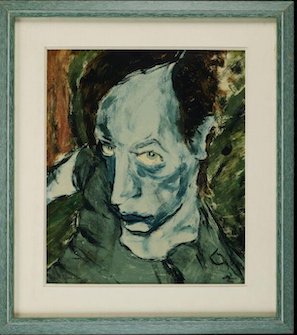 their best selling show garnering 68,000 advance tickets in the weeks before opening in London in March 2013, with a total of 300,000 visitors when it closed in July that year. Afterwards, the exhibition toured eleven other museums around the world and was seen by two million people, ending five years later in July 2018 at the Brooklyn Museum.
The David Bowie Centre
Bowie kept meticulous records of all his projects conserving every scrap of inspiration, costume, artwork, design, writing and recording. And, for the innately curious, the fantastic resource Order an Object at the David Bowie Centre allows the visitor a deeper dive into his archive. To pick only five from an overwhelming choice was not easy, but seeing them up close is an enriching experience, and I’ll definitely be back for more.
For my first foray I viewed a portrait Bowie made of Iggy Pop in 1976 entitled Portrait of J.O. (real name James Osterberg). This lithograph print of the singer’s head looking sideways with brooding eyes is expressively portrayed in black, blue and green on a brackish background.
An unexpected bonus was the painting Man With The Red Box (date unknown) set up in another study room. In this larger than life self-portrait Bowie stands under a birch tree in country garb with knee high riding boots; his eyes are rolling and his mouth is agape, with a mysterious red box in his hands. It feels like a strange twist on a bucolic scene by Gainsborough made with freely applied bursts of earthy brown, green and yellow pigments.
Of the many fan portraits he received over the years I chose a large pencil sketch portraying Bowie in his Ziggy Stardust phase. The large monochrome sketch dated 1994 by an unknown artist traces each feature and feathery hair on his head with exquisite sensitivity and precision.
T he atmosphere at the modern centre is friendly and relaxed, and viewers are encouraged to fully engage visually with their chosen objects. I was told my request for the original artwork by Edward Bell for Scary Monsters (And Super Creeps) (1980) is the first since it opened. The vibrant yellow background, the torn collage of words, polaroids and illustrations introduce Bowie in his elaborate grey Pierrot costume against his bold, black shadow. For me, this artwork evokes the excitement of Fashion, Ashes to Ashes and Scary Monsters as an integral part of the euphoric soundtrack to the post-punk, early eighties revolution in British style and culture.
Deep within the archive of iconic photos and posters is the less familiar image of Bowie in a loincloth by Anton Corbijn. His face is the picture of serenity, hands clasped to his naked chest, thumbs pressed gently together. The pose is one of vulnerable simplicity against a textured background, enhanced by a silver gelatin tint. It was taken backstage in New York before a performance of The Elephant Man (1980). On closer examination of the soft folds in the loincloth the rumours that Bowie was well hung comes to mind, which this image categorically confirms. 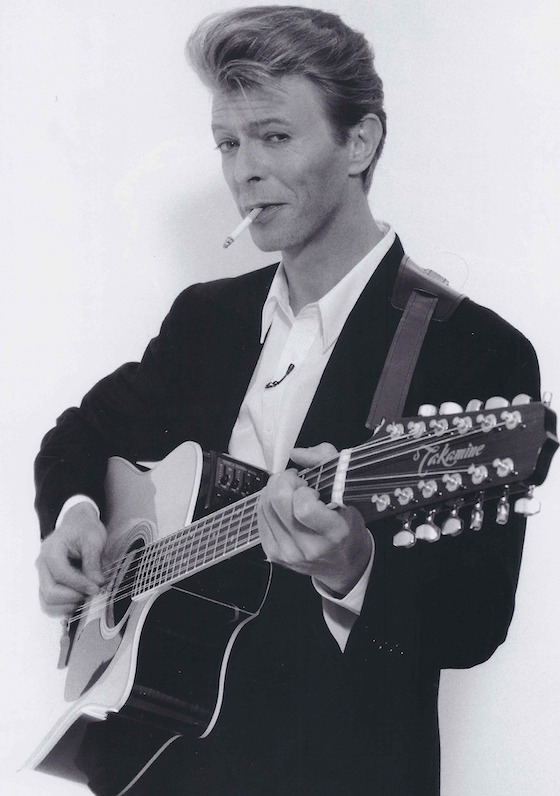
I fancied strumming one of his many guitars and dithered between a red Strat and his 12 string Takamine. In the end I went for the acoustic, which he may have played on Space Oddity (1969), but definitely used on his 1990 Sound and Vision tour. It’s decorated with the signatures of the three members of Placebo, Tony Visconti, Bowie ’99, and a Free Tibet sticker. This rare and desirable instrument is kept safely in its case, and touching is strictly forbidden.
Bowie was a huge supporter of Tibet House, a US charity dedicated to preserving Tibetan culture. He performed fundraising concerts alongside Philip Glass, Moby and Tibetan monks in 2001 at Carnegie Hall, and again in 2003, notably with head honcho of The Kinks Ray Davies.
Karma Man
“I watch the ripples change their size, but never leave the stream of warm impermanence…..”
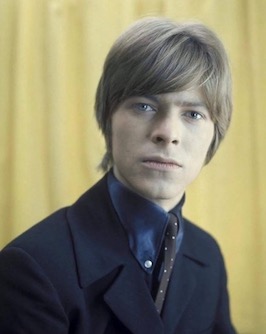 David Bowie’s long term collaboration with the producer Tony Visconti began with a quirky ditty called Karma Man (1967) and ended with Blackstar, a magnificent final album released on 8th January 2016, his 69th birthday. When he died just two days later there would be no public funeral, just a scattering of his ashes in Bali in accordance with Buddhist rituals and tradition.
Tibetan Buddhism became a spiritual thread throughout Bowie’s life after he attended the London School of Buddhism between the ages of seventeen and nineteen in the mid-1960’s. He had seriously contemplated becoming a monk during his studies under Lama Chime Rinpoche, who fortunately for the world of entertainment directed him towards becoming a musician and performer.
- Details
- Hits: 692
February 17th 2026
Sam Burcher revisits the Blitz Club via the current exhibition at The Design Museum
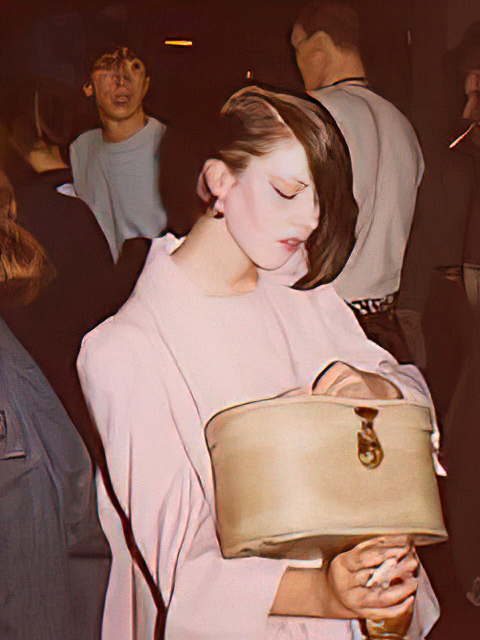 An old school friend recently attended Blitz - The Club that Shaped the 80's exhibition at the Design Museum in London. Afterwards, she wrote this opening paragraph in her recent feature for The Ox Magazine:
“The coolest girl in our school, also called Sam, was a couple of years older than me and she had been there. She told me about it using reverent tones in the cloakroom where we used to smoke illicit fags between lessons. It sounded so flamboyant and far out of my reach, I could only imagine what it would be like. Indeed she became an ardent attendee and joined the ranks of young creative people who went there religiously. They became known in the media as the Blitz Kids and some even rode a wave of publicity the club garnered to attain global success and celebrity status.
Today, the school she mentions is something of a Holy Grail for North London parents of clever girls. In 2024, it came top of the League Table of non-private girls school in the country. My parents were keen for me to go but, after passing the entrance exam, I was not minded to perform. Instead, by the time I was fourteen, I was committed to music, going to gigs, meeting other cool people, and by extension going to nightclubs. I didn’t worry about my age being discovered, because my presence was never questioned.
It is true I rubbed shoulders, and they were sometimes big pink padded shoulders, with the nascent star Boy George at The Blitz. On any given night you might look around and see Gary Numan swaying to the music, or Billy Idol squeezed into the DJ booth with Rusty Egan. One evening it was my good luck to meet David Essex having a quiet drink at the bar, and later David Bowie when he approached me in one of Steve Strange and Rusty’s clubs following The Blitz.
Some of the major players featured in the exhibition were already friends outside of the context of the club. I had first met the socialite Phillip Sallon on the bus to his day job at The Royal Opera House, George, before he added the pre-fix Boy on a train to a flat we briefly shared in Birmingham, and the designer Jon Baker, who we all called Mole, up a ladder in the grounds of said school, which was designed by Edwin Lutyens.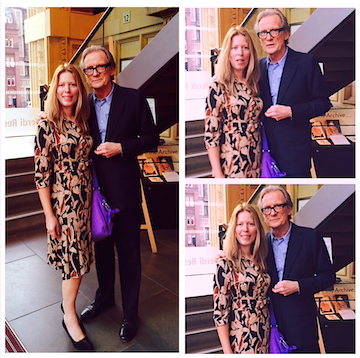
It’s also true I was there for one of the club’s seminal moments in December 1979. I remember waiting patiently for the band to come on, mindful of the last train home and school in the morning. I was curious after the lead singer Tony Hadley told me his band called Gentry, as Spandau Ballet was then known, were going to be famous. Thirty five years later, after much water under the bridge, I attended Spandau’s reunion gig and premiere of their rockumentary Soul Boys of the Western World at The Royal Albert Hall in 2014. Somewhere in the enthusiastic crowd I bumped into my dear friend Phillip who, after gasping at my youthful appearance, muttered wittily, “It won’t last!”
It was my pleasure to be escorted to The Albert Hall afterparty by the actor Bill Nighy, a true gentleman and pal of Gary Kemp. Sadly, this would be the last time I saw Mike Peters, the lead singer of The Alarm, a band I had the privilege of promoting during my years in A&R at IRS Records, with my friend and fellow Blitz Kid, Richard Law (Dick Breslaw), who was working with William Orbit, amongst others. IRS was owned by Miles Copeland III, the manager of The Police, a number of British bands, including Squeeze, and the American bands The Go Go's, The Bangles and REM. Sadly, the Spandau reunion would also be the last time I saw Steve Strange.
The Blitz Club in the spring of 1978 was my first encounter with Steve Strange, who, in his infinite wisdom, had an uncanny sense of the right people to admit into his club. It’s part of the club’s mythology that Mick Jagger was turned away, perhaps because he had not made the required effort to dress up. Steve was definitely not a follower, nor was he remotely interested in creating a movement. He was far more interested in being himself and attracting likeminded people into his creative ambit to share the enjoyment.
My Blitz Club membership card was numbered 201 on the back, which may support the fact that only a relatively small number of people were involved. I vividly remember entering the club and Steve pushing it over the wooden counter to me, and recognising this was an important moment. I suspected he liked my look: I had a youthful complexion, short, short, hair like a boy, and wore exceptionally good military clothing borrowed from the wardrobes of the theatrical costumiers Bermans & Nathans, because my brother worked there.
One morning a year or so later after a night out, I woke up in Steve’s living room in his flat off the Kings Road in Chelsea. When he saw me he said, “Shock! What are you doing here?” I explained that my friend had spent the night in his flatmate Rusty Egan's room. He led me to the kitchen and kindly offered me the means of making a cup of tea. When Steve and Rusty started Hell Club on Henrietta Street in Covent Garden after the Blitz, Steve would busily snap polaroids of the exotically dressed creatures parading passed him on the door. I remember thinking he’s going to have a great photo archive, because everyone looked great at the beginning of the night before the excesses of drinking and dancing took effect. I later read in his autobiography Blitzed!(2002), that his collection of photographs was lost in a house fire.
 I enjoyed the hustle and bustle of Covent Garden, which was not so long ago a busy flower and fruit & veg market. It was around the corner from the Blitz on Great Queen Street, which I knew already for its Motown and soul nights on Sunday evenings before the Tuesday nights got started. To me the area felt comfortable and familiar, having been born nearby at the old Charing Cross Hospital on The Strand. There was live music in the underground vault at the Rock Garden, and its cafe upstairs served a mean burger and crisp white wine at tables spilling onto the cobbled streets of the Piazza. New wine bars like Rumours on Heddon Street had opened mixing intoxicating cocktails, where people like me stood out against business suits, double denim or pegs with perms.
My attendance at clubs and gigs was pretty extensive for a very young teen at a time when live music was cheap and plentiful. I’d strayed into Soho to see The Damned at The Marquee, The Clash at the Lyceum Ballroom, and numerous bands at the 100 Club. And travelled further afield to The Music Machine and The Electric Ballroom in Camden for Devo and The Cramps, or to the other Roxy in Harlesden for The Clash again. A great gig was The Stray Cats and Elvis Costello at The Roundhouse where Bob Geldof was bouncing around chatting to everyone. In May 1979, there was a spectacular night of Roxy Music led by Bryan Ferry in a lemon yellow suit designed by Anthony Price, with Annie Lennox and Dave Stewart supporting in their early incarnation as The Tourists
I loved the sensations of live music, the sound waves oscillating through the speakers and into my body in these cherished smaller venues. But, it was harder to connect to the music and the musicians in larger venues. I saw Bowie’s Isolar tour at the Earl’s Court Arena in the summer of 1978, which led to a series of Birmingham adventures (see Make Me Up I & II). The Hammersmith Odeon was the venue for Kraftwerk's stunning Computer World Tour in the summer of 1981, where Autobahn, Die Roboter and Neon Lights shone as the apotheosis of the transEuropean electronic sound. The big screens behind the band seemed to bring them closer to the seated audience. And, in an effort to make that connection, I got down to the front row of 65,000 people at the Milton Keynes Bowl for David Bowie's Serious Moonlight tour in July 1983. It was scorchingly hot and Bowie wisely made sure the security guards sprayed us with cold water at regular intervals.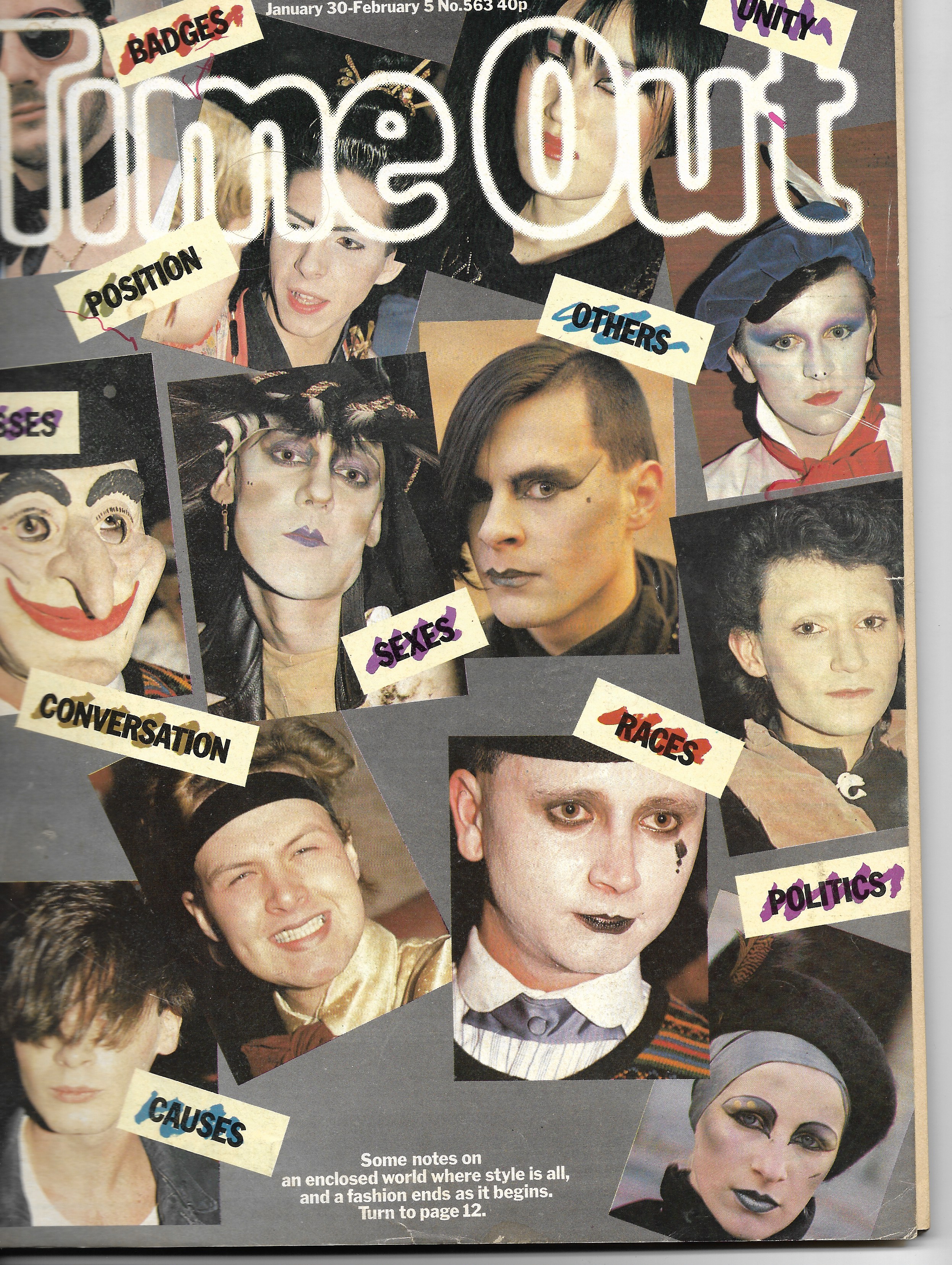
1980 had dawned full of musical promise with Spandau's spring, summer and winter gigs on the HMS Belfast, under the arches at Heaven in Charing Cross and at the Scala Cinema respectively. In between was the launch party of I-D magazine, then priced at 50p. For all the above occasions I was elegantly encased in silk and fur and hats. At this time I was dating Richard Jobson, the lead singer of The Skids. His August gig at the Hammersmith Palais had the added bonus of a superb set by Simple Minds, led by fellow Scot Jim Kerr. In December, Duran Duran played one of their first ever London gigs at the Venue Victoria, with Midge Ure a prominent attendee.
The atmosphere on South Molton Street, just off Bond Street was another lure for me. It was easy to reach on the new Jubilee Line from the suburbs, and it had a great pub on the corner called The Hog in the Pound. After reading Twiggy’s autobiography, I knew she modelled for Vidal Sassoon, who had (and still has) a salon there. I was doing the same in 1980, but was all too aware of my limitations as a model. I’d also read Joan Collins's autobiography and learned her trick of using eye drops every morning to make my eyes shine. I was absorbing London, and recognised the importance of being stylish. I was convinced of wanting to do something creative, but had yet to take my ‘O’ levels.
The Face and Other Magazines
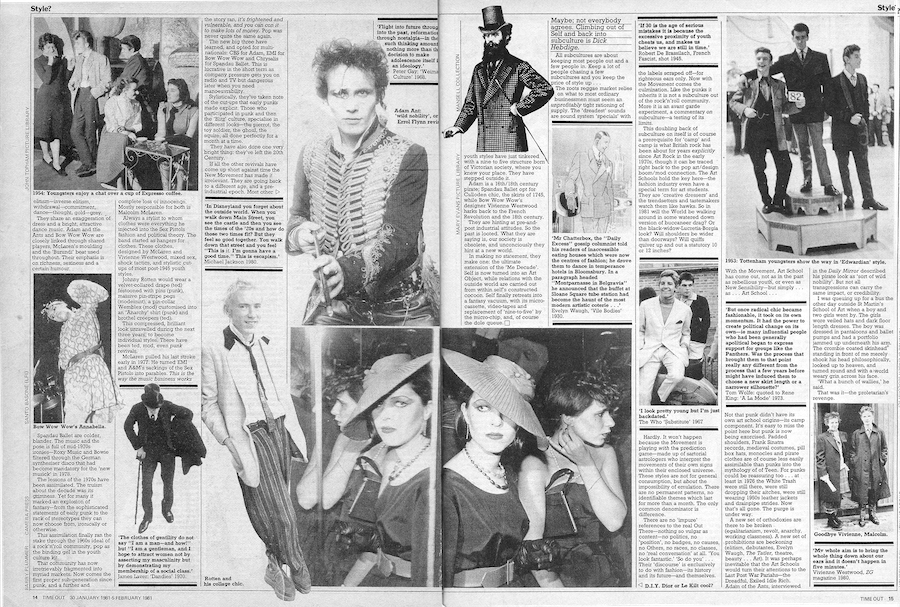
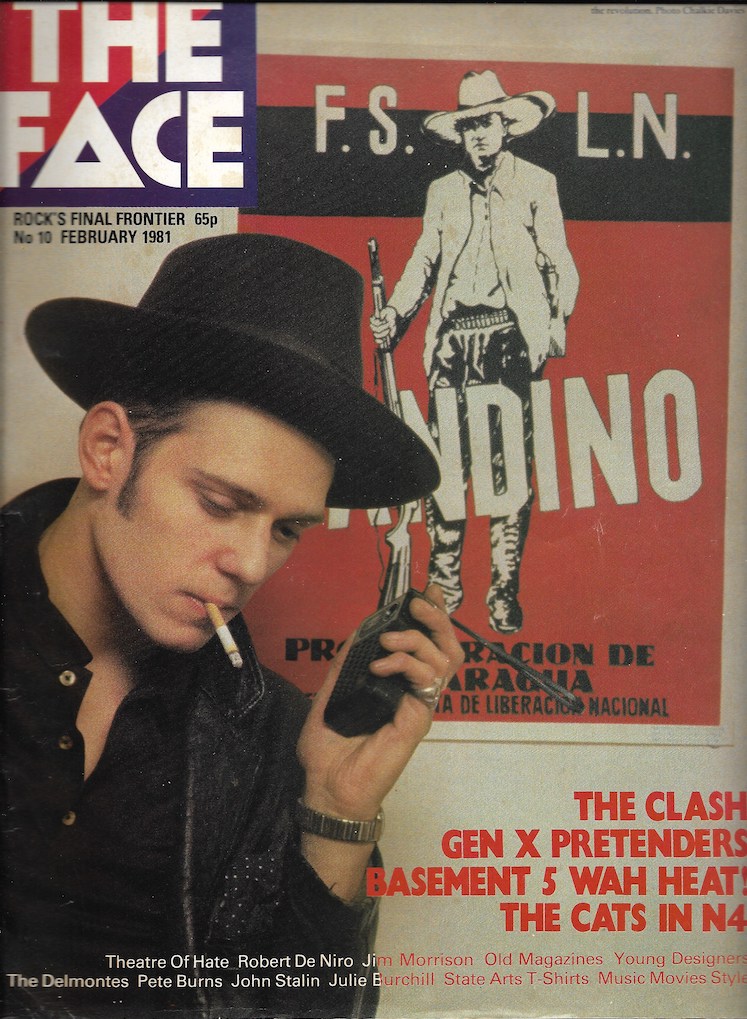 Despite my youth, my eyes and ears were tuned to the Zeitgeist. And, as a result, I appeared in a number of British magazines, including The Face, Time Out, New Sounds New Styles with Steve Strange on the cover, and Girl About Town. Time Out’s four page feature described us as a somewhat vacuous youth movement akin to style astrologers with no real depth, and the music as a little bland. There were no first hand quotes or contributions by any of us in what Girl About Town labelled as, "The cult with no name."
But, that changed in 1980, when the German publications Madchen and Popcorn came to London. Madchen, a teen magazine ran a three page feature under the Editorial heading "Beautiful People...the people who really do the most outlandish and crazy things...And the best part is no-one really pays them any attention." Apparently, the appeal for Madchen readers was that Londoners could enjoy dressing up however they liked, which, according to the Editor, was literally a crash course in tolerance for Germans.
Steve Strange, me and a few others had been asked to model clothes designed by Martin Degville, who Madchen described as. " a former art student who dresses half-male and half-female and causes a stir with sack-like fantasy creations." Steve, then aged 20, and I did the talking and he eloquently said,”Bowie inspired us the most. We're countering aggressive punk with total beauty – without taboos!"Unused to being the voice of a generation, I added less eloquently, "When you walk around all dressed up in the evening you're someone special!” I had invited many of my friends to participate in the Blitz. So, I took this opportunity to advocate the joyful feeling of dressing up and having a wonderful night after a dull day in school uniform to a wider audience.
Popcorn, a German music magazine, was patently more open minded. They were primed about the music, and Steve and I filled in the gaps on fashion. We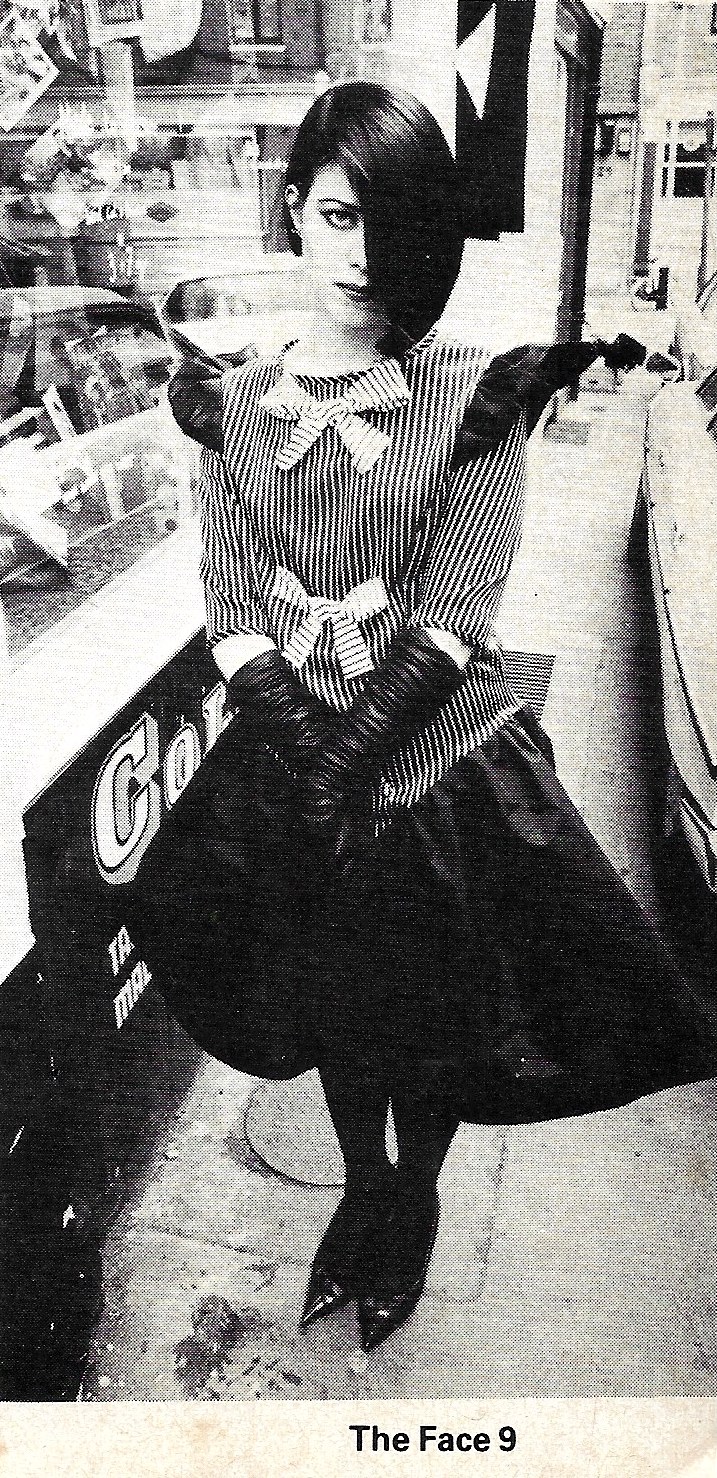 told them where we got our clothes from, how and why Blitz Kids dressed the way we did, and the clubs in London. In turn, they correctly referenced The Blitz, Hell, Le Kilt, and The Beatroute, Billy's, and Studio 21, alongside the bands; Shock, Spandau Ballet, Steve Strange and Visage, Soft Cell, and Split Enz.
I reckoned the German music audience must be interested in us because of the connection with David Bowie, Brian Eno, Iggy Pop and Lou Reed all recording and living in Berlin at one time or another. The new bands like Soft Cell were also recording in Berlin, and still do to this day. Warming to my theme of transformational dressing, the Popcorn article states, "It was just so boring to always walk around looking so dirty and sloppy," says 16-year-old Samantha. 'I get a huge kick out of dressing up and designing the craziest clothes myself. That includes flashy makeup – preferably in pink and black. Black is just so cool!” And, although it pains me to recall it, according to the translation in Madchen I offered up this salvo, "We're way cooler than the rest of the world."
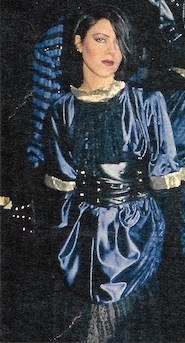 A week or so later, a couple of photos from the session shot on Carnaby Street ended up in The Face. Issue 9, 1981, with Paul Simenon of The Clash on the cover. I’d half hoped to see my picture alongside the many others collaged over the walls of the National Portrait Gallery’s 2025 retrospective of The Face Magazine: Culture Shift exhibition. But, the issue was overlooked entirely. Another erasure was a portrait taken at The Blitz by Derek Ridgers, a photographer named in The Times list of top hundredphotographers, and published in the first edition of his coffee table book London Youth 78-87. Yet, as I had already suspected this photo had been replaced in the second edition, which was on sale at the exhibition. This I found slightly odd, since Derek had recommended the Emmy-winning news correspondent Alice Hines interview me as a credible source of information about the era, and specifically about his photo of me, which she did. https://samburcher.com/index.php/articles/notes-on/78-87-london-youth
After looking at all the great fashion and music photography at The National Portrait Gallery, especially the Kate Moss portraits and the I Britpop hands, I decided it was a humbling experience to have been left out of the exhibition and the second edition. I remembered that after a girls night out at Eve Ferret’s hilarious show at the Crazy Coqs at Zedels in Piccadilly Circus, Pinkie Tessa a prominent and glamorous Blitz attendee told me she is not the least bit bothered about the past. Whilst she still dresses up in her own inimitable style, she’s more interested in perfecting her ice skating and golf skills in the present moment. Eve, another Blitz regular and performer with her cabaret duo Biddy and Eve, still brings the house down on her own.
But, when I bumped Into Princess Julia in the National Gallery’s Audrey Cafe after The Face Exhibition, she did not hide her disappointment at being overlooked. Julia was a regular DJ at the Blitz, and the stunner speaking the French dialogue in Visage’s Fade to Grey (1980) video. To this day she is DJ’ing in nightclubs and mingling with cool young hipsters.
- Details
- Hits: 639
January 15th 2026
I arrive into what feels like Paris of the past, of flea bitten mattresses, and the charming reek of damp furnishings in shuttered corners, out of the sun. Sam Burcher
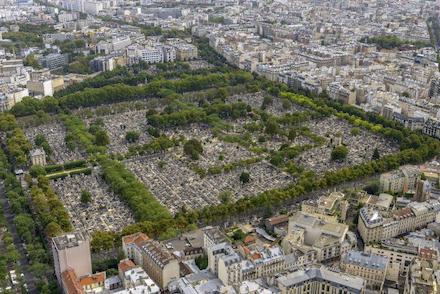 It seems to me that life and death are never far away in Paris. An Artic wind persistently stirs the air in May. Paris wants my bones, but it can wait. It already has millions of bones in seventy thousand tombs in Père
Lachaise, where the burial shafts go surprisingly deep. I peer inside an open tomb, directly behind Oscar Wilde’s glorious flying Sphinx. Its heavy stone lid has been slid to one side and rests on a wooden sawhorse. A ladder placed inside waits for the descent of a climber to receive the freshly interred body on its last journey underground.
Billions more bones are stacked beneath this city. The long bones, small bones and skulls of six million people are piled high in the catacombs running sixty five feet deep under the lively streets. My days of wandering overground have convinced me that Paris is the place where poets come to die. Consider the Irishman Oscar Wilde and the American Jim Morrison, illustrious, but exiled poets reviled by many in their native countries. Yet, Paris welcomed them, then subsumed their bones to rest in peace forever.
The French have long revered the poets buried in Paris’s largest cemetery garden named after the confessor of Louis XIV, Father François d'Aix de La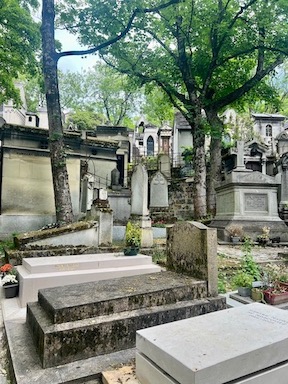 Chaise. Here lie Guillaume Apollinaire, Honoré de Balzac and Molière to name but a few. For me, a homesick outsider, the loveliest structures in this meditative English-style park are the manifold trees forming a purifying canopy. My intention to revisit the graves of Wilde and Morrison and to seek out Chopin and Colette is peppered by distractions. All around ivy twists and turns amongst the trees. I am lost on the cobbled paths of the Divisions.
Père Lachaise is crammed with all sorts of tombs. Vaults house the dead in stone drawers, the mossy epitaphs to who they were in life have weathered. Some lie under thick slabs of glinting black granite with gold symbols and letters which gleam in the sunlight. Others recline in Gothic tombs laden with angels, flower motifs, symbolic handshakes, intertwining snakes, and the grotesque heads of otherworldly animals. Some are now supine bronze likenesses of their former selves hovering over a casket of bones.
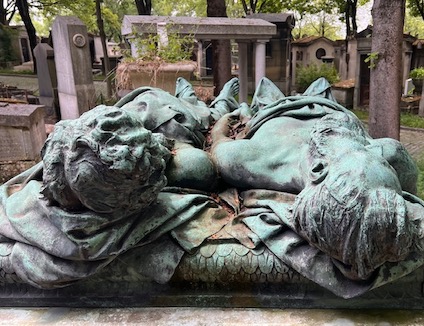 Take for example the hot air balloonists Joseph Croce-Spinelli and Théodore Sivel, a pair of science mad adventurers who died of oxygen depletion at 28,000 feet, an altitude known as, “the death zone.” These co-pilots of the Zenith became indifferent to their perilous situation, and were happy to rise and rise. Now, they lie side by side atop a tomb, their verdigris figures with fingers entwined have been grounded for eternity.
A bronze figure with the unlikely reputation of being a fertility symbol belongs to Victor Noir. His likeness is regularly caressed or even mounted by females hopeful of conceiving. His mouth, nose, crotch and feet gleam against his tarnished prone figure, bearing witness to a bizarre ritual that apparently has brought joy to thousands of women. In life Victor was a journalist who was shot dead in a dual by Prince Pierre Bonaparte, a cousin of the then ruling Emperor Napoleon III, who became a symbol of the Revolution within a year of his death.
Many of the smaller vertical tombs are reminiscent of telephone boxes, but wider and deeper. The hinges of oxidised doors that once secured a place of prayer and reflection are shorn. Inside the rickety chairs, crumbling urns and vases filled with ancient flowers on wonky tomb shelves are dusty and unloved. Stained glass windows that once glowed so beautifully are smashed, the faces of Jesus and the Saints have gone missing.
The grand mausoleums akin to small Greek temples which crowd the hills and fields have fared better. Intricately carved symbols meaningful to the family decorate the formal and ornate architecture. A reverence for bygone traditions remains intact and the families of passed on loved ones maintain these well-tended tombs.
Countess Stroganoff
One of the grandest mausoleums is too lofty, too mysterious, and too arcane to overlook. It belongs to the Russian Countess Stroganoff, also known as Elizabeth Demidoff. Her story is too strange not to tell. The Countess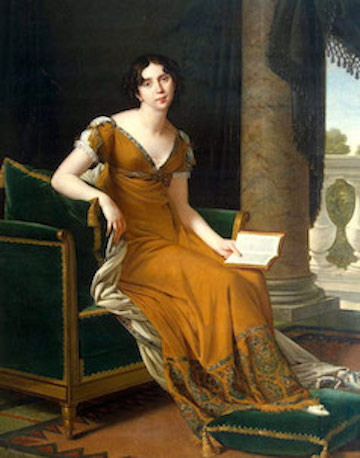 Elizaveta Alexandrovna Stroganova, the mother in law of a Napoleonic princess, was a married woman who left her husband and four children in Rome. For a time she lived a glamorous society life in Paris, but succumbed to an illness aged just 41.
Her tomb in the 19th Division is topped with towering white marble columns above magnificent stone mausoleum. Every inch is covered with intricate carvings of knots, hammers and bats, and the protruding heads of wolves and bears. A stone frieze of sables, a small furry animal, similar to a weasel runs around its surface.
The images of the sables trigger memories of a sighting of an unusual and wounded animal a couple of nights before in nearby Belleville. I wondered how it came to be roaming the city streets. Could it be a ferret, a weasel or maybe even a mink? I watched it repeatedly fail to jump a lowish wall overhung by a tree. It was limping and the damaged leg impeded its spring.
Other observers had gathered and were shining phone torches on the poor creature. No longer able to watch, I walked away praying it would live another day. And just days later, the animal on the tomb of Countess Stroganoff struck a chord. The sables represented her source of immense wealth from the Russian fur trade. I began to fantasise the stout legged creature was a sable signalling the presence of the Countess eternally resonates in Paris.
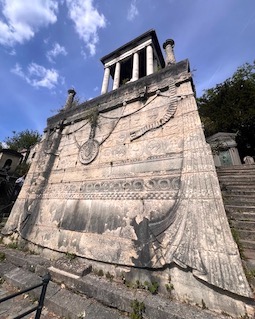 Sometime after her death, a rumour began to circulate about a strange and enticing caveat in her Will. In 1893 the French newspaper La Justice issued a challenge purportedly set by the Countess that anyone who stayed in her tomb for a year would win one million francs. Countless other newspapers around the world ran the story claiming her body was perfectly preserved in a crystal coffin within the walls lined with plate glass mirrors. The willing applicants could leave the tomb twice a day at dawn and dusk for an hour’s walk, could not work, and meals would be brought in to them.
The rumours became wilder with each passing year, as the reward increased to five million francs. One candidate, who lasted the longest, was a gibbering wreck after three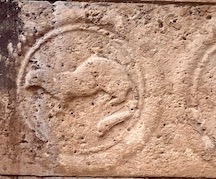 weeks. The outlandish claim emerged that the Countess was, in fact, a vampire. The origin of this story is most likely a work of German fiction by Karl Hans Strobl, which translates into The Mausoleum on the Père Lachaise (1917). This was followed by the French tales of The Guardian of the Cemetery and The Graveyard Duchess (1919), translated into English in 1934 and The Cemetery Watchman (1965), a story in which a Countess preys on the men paid to guard her tomb. The reports circulated many years after her death, so although intriguing, are most likely untrue.
- Details
- Hits: 466
8th January 2026
Sam Burcher enters the Maison and Museum Gainsbourg to explore the life and loves of France’s most prolific modern composer.
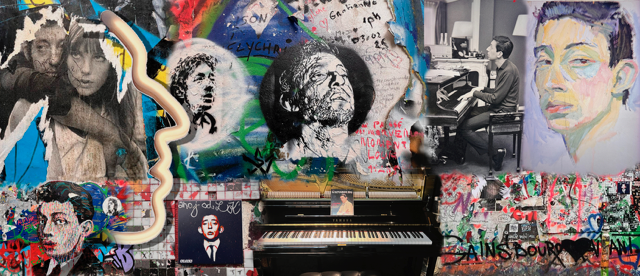 Maison Gainsbourg situated at 5 Rue de Verneuil in the stylish St Germain district of Paris is almost exactly as Serge Gainsbourg, the singer, actor, writer, composer, photographer and director, left it when he died in 1991. Now, the heavily graffitied building serves as his permanent House Museum, where visitors are intimately guided room by room by his daughter Charlotte Gainsbourg, whose sweet tones enter your ears via a headset. Like many French dwellings, it’s a curious mixture of grand elegance and modest simplicity.
Charlotte invites me to open the black door to the right inside the main entrance and step onto the elegant porcelain tiles of the salon, which runs the entire length of the building. At the far end sits a Steinway baby grand piano, and a smaller upright piano. Closer to me is a portrait of the French icon Brigitte Bardot and a row of gold discs, awarded to Serge for his millions of record sales. She confides that her father never taught her to play the piano because he described the experience of being taught by his father as “torture.”
But, as a result of his musical torture, Serge composed the Eurovision Song Contest winner in 1965, a string of hits for and about Brigitte Bardot, including Harley Davidson (1968) Bonnie and Clyde (1968) and The Initials B.B (1968) with a masterful string section based on Dvořák's New World Symphony (No. 9). The love song Jane B on the B side of the multi million selling single Je t'aime...moi non plus (1969) was inspired by Chopin's Fourth Prelude from Opus.28 in E Minor.
Jane Birkin (right with Brigitte Bardot) was a British actress, model and singer, who met Serge Gainsbourg on the film set of Slogan in 1968. He was forty, she was twenty one, and it was not love at first sight. She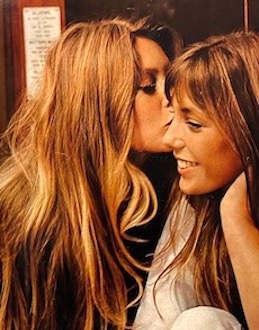 thought he was ugly and he didn’t think she was great looking. By the end of the movie they were infatuated with each other and began a fruitful musical collaboration including the albums Serge Gainsbourg & Jane Birkin (1969) and L’ Histoire de Melody Nelson (1971). The duo continued to work together even after they separated in 1980.
In her insightful auto-biographical Munkey Diaries 1957-1982, Jane Birkin prophetically writes,”So living with Serge in his little house in Rue de Verneuil was delightful but complicated. It was rather like living in a museum. In his salon every object had its place and the children weren’t allowed to touch the piano.”
Their daughter Charlotte Gainsbourg was born in 1971. She is an accomplished model and actress, the winner of two César Awards and the Cannes Film Festival Best Actress Award in 2009. In Franco Zeffirelli’s Jane Eyre (1996) she played the title role. She starred in Lars von Triers’s compelling Nymphomaniac I and II (2013), and was directed by her father in Charlotte Forever (1986). As a successful musician she collaborated with Jarvis Cocker on 5:55 (2006) and Beck on IRM (2010) and Time of the Assassins (2010).
The tiny kitchen at the back of Maison Gainsbourg is reached by the long corridor running parallel with the salon. Here, Serge prepared dinner so he and Charlotte could settle down to watch every single one of his performances on the small black and white television in the corner. She recalls her parents often went out all night enjoying the glamorous night clubs of Paris, and her mother happily picking her up from school in the afternoons. Her father, she said, never rose before 1pm.
I am guided upstairs, passing Serge’s capsule wardrobe of blue jeans, white t shirts, black jackets and soft white shoes, but never socks, not even in the snow. Endearing photographs of Marilyn Monroe and the almost otherworldly beauty of Jane Birkin adorn the long passage to the bathroom. Charlotte confides that although scrupulously clean, her father preferred to perform all of his ablutions in the bidet. 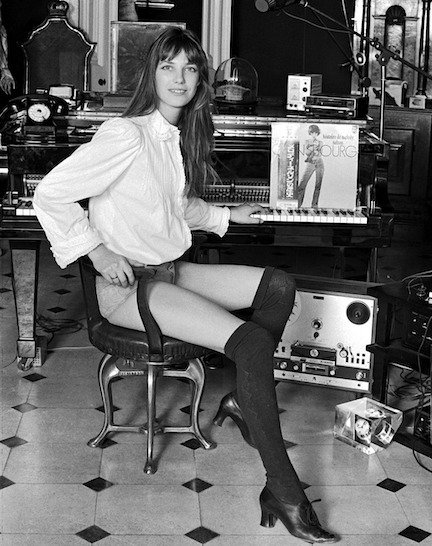 In contrast, her mother loved to jump into the bath with both of her daughters. When she was eighteen Birkin married John Barry with whom she had one daughter, Kate. Barry composed eleven of the James Bond themes, the film scores for Out of Africa (1985) and Midnight Cowboy (1969) and the soulful song Born Free (1966). As a child Charlotte (left) measured her growth by her head getting closer to and eventually touching the glass ball dangling from the Venetian chandelier strung ever so low from the bathroom ceiling.
The house provided an essential part of Charlotte’s education. The family’s fame precluded visits to museums and galleries, so she learnt from the books in her father’s study. She earned pocket money by tidying her mother’s messy wicker baskets, which famously morphed into the iconic Hermès, Birkin Bag. After her parents separated, her mother’s topsy-turvy room was used solely to display her father’s collection of antiques dolls, which she found creepy.
Lastly, I arrive at the bedroom where Serge died in his sleep in 1991.The heavily black velvet clad room has a decorative screen and an ornate Baroque bench carved in the shape of a mermaid reclines at the end of the low, wide bed. This is where his body was embalmed so his family and friends could spend more time with him. Being close to his cold, dead body was better than not having him there at all, Charlotte says.
In life, Serge Gainsborough was a prodigiously gifted artist, in private he was delightfully mischievous. He particularly enjoyed the company of the policeman he met on his nightly perambulations around Paris, and liked nothing more than to invite them home for a drink. Then, after hours of conversation, they were invariably persuaded to give him their badge of office, and even on occasion, a pair of handcuffs A long glass table in the living room is laden with dozens of badges, something a gendarme is strictly forbidden to part with.
- Details
- Hits: 791
18th December 2025
Sam Burcher visits L’ Hôtel in the heart of the Left Bank one hundred and twenty five years after Oscar Wilde died here.
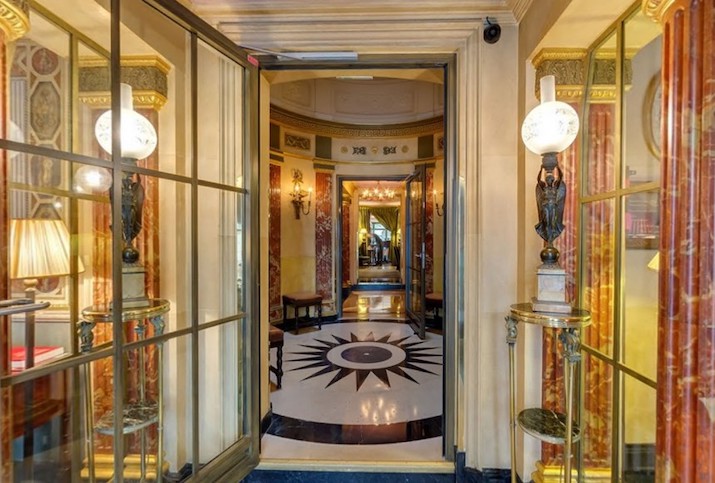 I met Florian Liger-Bernard, a front desk concierge at L’ Hôtel, in St. Germain des Prés, to discuss the minutiae of Oscar Wilde’s stay until his death on 30th November 1900. He told me about the many other celebrities who have followed in the famous Irish writer’s footsteps since then. “There can be no coincidence if you choose to stay at L’Hôtel. It is a form of decadence,” he said.
The original building was created in 1828 by Célestin-Joseph Happe on the exact spot occupied by Queen Margot’s 17th century palace, the Pavillon d’Amour. After several iterations, it underwent a significant refurbishment in 1967 after Edmond Dreyfus, the Parisian king of textiles purchased the hotel in 1963, which had fallen into disrepair.
Over the last twenty years, the new owners, part of the Curious Group of Hotels, The Portobello Hotel, London, Canal House, Amsterdam and Drakes, Brighton, have further transformed L’Hôtel. They utilised the extraordinary skills of interior designer Jacques Garcia, the recipient of numerous cultural prizes, including Chevalier in the Order of the Légion d’honneur and the Oscar Wilde Prize in 2002.
Once open to all the elements, the central atrium is now snugly under glass. If you look up directly after entering the lobby it appears as an elegant circular tower with exquisitely lit balconies and arches on each floor interspersed with reliefs of classical figures.
Around the tower a staircase spiralling six floors is covered in a luxurious leopard print carpet. Small indentations on the handrail burnished from hundreds of years of use attest to the innumerable and celebrated hands that may have caressed the same beautiful imperfections. 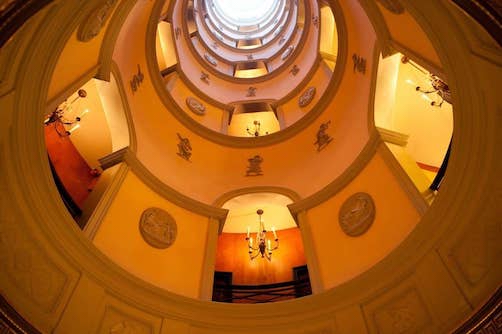
The bedrooms are variously named L’ Apartment, Bijoux, Chic, Grand, Mignon, Reine Hortense, and of course, Oscar Wilde Suite. Each room is individually and sumptuously decorated in the epitome of impeccable French style. There is an ambience of charm, comfort and warmth inside one of Paris’s first and most beloved five star boutique hotels.
In the Venetian room number 30 on the third floor the walls are textured in finely striped golden velvet, the bedhead is a profusion of intricately carved wooden leaves in a Rococo style with burgundy drapes on either side. A crystal chandelier shimmers over the centre of the bed. The Rosso Francia marble that proliferates throughout the building extends to the deep bathtub.
After an exceptional breakfast Florian shows me the photographs in the bar of previous guests; Elizabeth Taylor and Richard Burton, Salvador Dali, Princess Grace, and Frank Sinatra, who romanced Ava Gardner in The City of Love. He points out the grainy deathbed photo of Oscar Wilde. We respectfully discuss his life and death in a quiet nook full of hardback books.
The Rise and Fall of Oscar Wilde
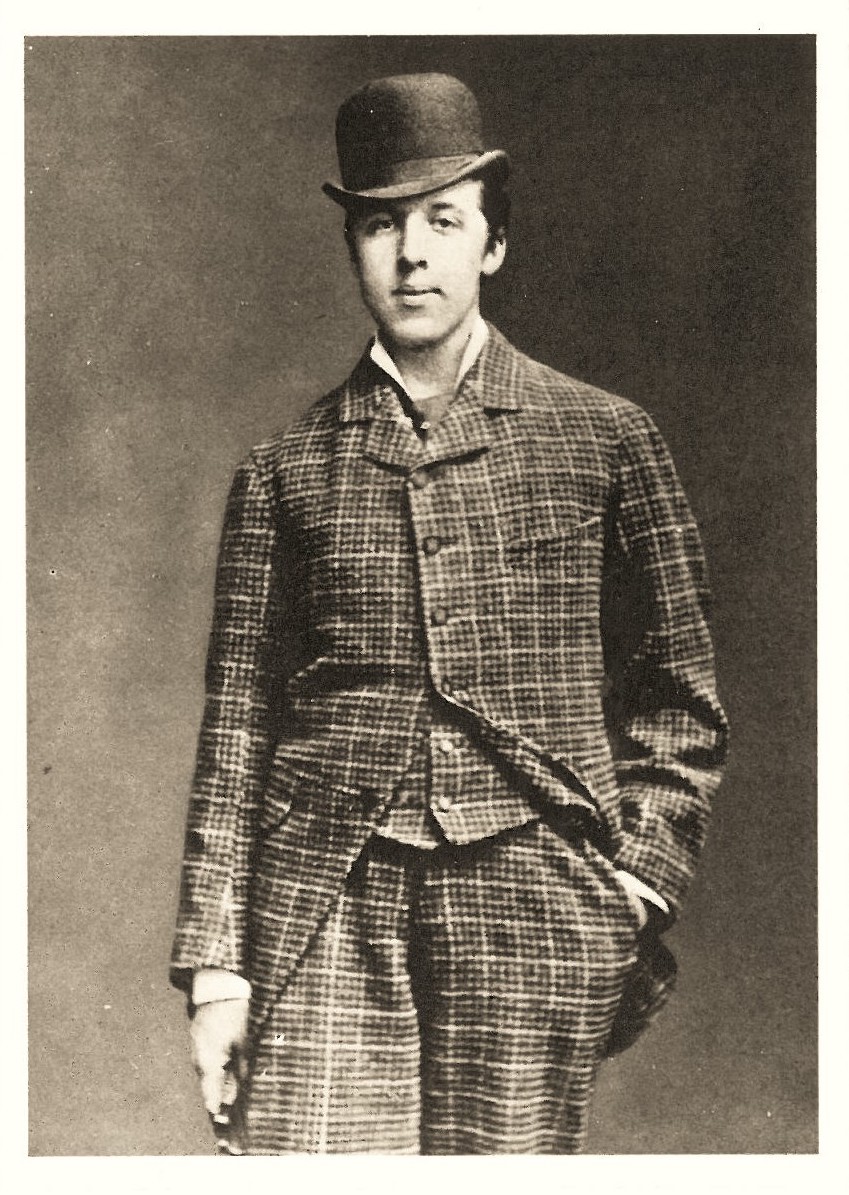 There would be no luxury for Oscar Wilde following his disastrous libel trial in London in 1895. The case against the 9th Duke of Queensbury’s claims of homosexuality, at the time a criminal offence, had led to Wilde's conviction of gross indecency and two years hard labour in Reading Gaol.
Consequently, when he arrived in Paris in February 1898 his health was considerably weakened. And, matters did not improve, since L’ Hôtel had yet to become the luxury establishment it is today. Wilde checked in under the pseudonym of Sebastian Melmoth to a shabby rather than chic Hôtel d’Alsace, its draughty atrium open to the elements.
His eighteen month residency was an unhappy one, not least because he had once been accustomed to and craved beauty. From his sickbed Wilde famously said, “My wallpaper and I are fighting a duel to the death. One or the other of us will have to go.”
The libel trial had bankrupted him, and although he still received royalties from his English and Irish publishers, the cheques were slow to arrive. To tide him over, the French Government acted to give Wilde some money demonstrating its benevolence towards the arts, a tradition which extends to foreign artists to this day.
When he died aged 46 there were no funds left. Oscar Wilde succumbed to a swelling on his brain, caused by a fall in prison and an infection from two surgeries performed in his room to remedy it. His final hotel bill went unpaid for two years after his death, until his literary executor Robert Ross arrived in Paris to settle it.
The last invoice is amongst the framed mementos on the gilded peacock walls of Room 16. The Oscar Wilde Suite represents an opulent homage to the writer, but there is speculation about whether he died here. As his health deteriorated, he was too ill to climb the spiral staircase to his first floor room. According to the social media page of The Oscar Wilde Appreciation Society, Oscar moved to a room downstairs to have surgery, but for the final two weeks he returned to his room on the upper floor.
No-one can be completely sure, but the room on the ground floor is now possibly the elegant niche in Wilde’s Lounge where the finest champagne and classic cocktails are served with bright green Italian olives and roasted cashews. I think Oscar, who said, I have the simplest tastes. I am always satisfied with the best,” would approve.
- Details
- Hits: 1198
September 5th 2025
Sam Burcher examines the lesser known role of the author and Poet Laureate John Masefield as a journalist and spy-writer during the Great War.
The contribution of the poet and author John Masefield to The Manchester Guardian, founded in 1821, has been radically 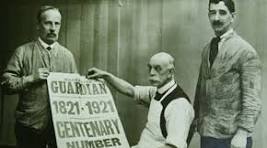 understated both by the writer himself and by those who worked on the newspaper. He was initially employed on a trial basis, becoming a regular contributor after distinguishing himself with several outstanding back pages. The name of the broadsheet was shortened to The Guardian in 1959 after widening its reach to beyond Manchester.
Between 1903 and 1924 some 390 articles by the future Poet Laureate were published. Of these only five were poems, the rest were miscellaneous articles, short stories, prose and a various reviews.
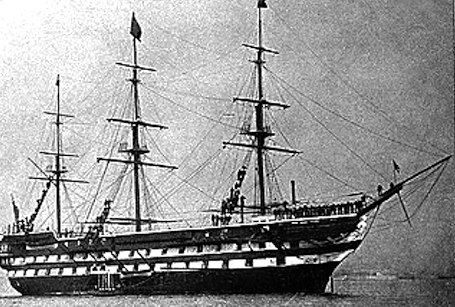 Masefield’s debut collection Salt Water Ballads (1902 )included perhaps his best known poem Sea Fever, in which he reflects upon the wild call of the oceans. He had voluntarily joined the marines as a thirteen year old orphan to escape his nagging aunt’s disapproval of what she called his “compulsive reading.” Several years later, he jumped ship in New York, working in a carpet factory by day and bartending late into the evening. By night he read voraciously, Chaucer's Canterbury Tales sealing his decision to become a writer.
After his discharge as a DBS, a distressed British seaman abroad, Masefield later spun the sights and sounds of his awe-inspiring sea voyages, and a near shipwreck around Cape Horn into his epic and visionary poem Dauber (1913).
Time spent in America left Masefield ideally placed for the second strand of his role at The Guardian, which was the collection of miscellany from the American Press. It is probable that his column inspired the Guardian Weekly, which began in 1919. And, as I discovered, his information gathering penetrated far deeper into American society. In fact, Masefield was part of a secret ring of spy-writers enlisted by the War Propaganda Bureau (WPB) during World War I, its purpose to counteract German influence in neutral countries, specifically America.
- Details
- Hits: 1512
21st May 2025
 ASSOCIATED PRESS REPORT FROM PARIS, 21st May 2025: -- Police have found a bust of Jim Morrison that was stolen nearly four decades ago from the Paris grave that has long been a place of pilgrimage for fans of the legendary Doors singer and poet.
The bust taken in 1988 from Père-Lachaise cemetery was found during an unrelated investigation conducted by a financial anti-corruption unit, Paris police said in an Instagram post Monday.
There was no immediate word on whether the bust would be returned to the grave or what other investigation might take place.
Morrison, the singer of Doors classics including “Light My Fire,” “Break on Through,” and “The End,” was found dead in a Paris bathtub at age 27 in 1971.
He was buried at Père-Lachaise, the city's cemetery that is the final resting place of scores of artists, writers and other cultural luminaries including Marcel Proust, Oscar Wilde, Gertrude Stein and Edith Piaf.
The 300-pound bust made by Croatian sculptor Mladen Mikulin was added to the grave in 1981 for the 10th anniversary of the singer's death.
“I think it would be incredible if they put the bust back onto where it was and it would attract so many more people, but the cemetery wouldn’t even be able to hold that many people,” Paris tour guide Jade Jezzini told The Associated Press. “The amount of people who would rush in here just to see the bust to take pictures of it, it would be incredible.”
Known for his dark lyrics, wavy locks, leather pants, theatrical stage presence and mystical manner, Morrison has inspired generations of acolytes who congregate at his grave to reflect and sometimes to party, including a major gathering for the 50th anniversary of his death. The site has often been covered with flowers, poetic graffiti and liquor bottles left in tribute.
He was undergoing a cultural renaissance when the bust was stolen in the late 1980s, which peaked with the 1991 Oliver Stone film “The Doors,” in which Val Kilmer, who died in April , played Morrison.
London artist Sam Burcher recently returned to the now more subdued grave site that she first visited 40 years ago when the sculpture of Morrison was still in place.
“The bust was much smaller than all of these grand tombs. It was very modest, so I was quite surprised by that,” she told the AP. “But the other thing was the atmosphere, it was buzzing. There were people partying, smoking, music, dancing, and then I brought strawberries and kind of gave them out to everyone ... it was just such an amazing experience.”
Morrison cofounded the Doors in Los Angeles in 1965 with Ray Manzarek. Robby Krieger and John Densmore joined soon after.
The band and its frontman burned brightly but briefly, releasing albums including “The Doors” “Strange Days," and “Morrison Hotel, whose The California site that gave that album its name and cover image was seriously damaged in a fire last year.
After their final album, 1971’s “L.A. Woman,” Morrison moved to Paris. His cause of death was listed as heart failure, though no autopsy was performed as none was required by law. Disputes and myths have surrounded the death and added to his mystique.
https://www.dailymotion.com/video/x9jw6b6
- Details
- Hits: 1889
25th April 2025
On her quest for the eternal spirit of poetry, Sam Burcher meets the Mancunian poet and spoken word performer Stephen Belowsky in West Hollywood.

Stephen and I bond over a shared dislike of over-chlorinated swimming pools, which is the case in our hotel pool on West Sunset. Stephen’s eyes are red and sore and he’s a worried man. Later that day, I see him on the Strip; sunglasses on, almost as if in a trance, picking up the stories and energies on this world renowned street. I know better than to interrupt his flow.
The next day he bounces into the discrete nook on the hotel’s sun balcony. He flicks up his sunglasses to show me his clear eyes are healed after the application of eyedrops prescribed by the chemist. He announces he’s just had breakfast with Neil Sedaka and flashes a selfie. I’m aware of the popular tunes of singer-songwriter Neil Sedaka, but who is Stephen Belowsky?
Turns out, he is the only two times winner of the Western Australia Poetry Slam and twice an Australian Poetry Championship finalist. Originally from Manchester, his family emigrated to Australia when he was a youngster. But Belowsky couldn’t settle, bouncing between Manchester, Perth, New York and LA. He was the in-house poet at the Standard Hotel, where Creation Records founder Alan McGee, who released Stephen’s single 2020 Ball Drop on his Creation 23 label during lockdown, was the sometime DJ.
How do you write your poems?
“Every poem’s got a story, there’s always a reason,” Stephen said. Stay Greasy Baby is about when he had a HairBear Bunch afro combed style. And, because he was losing his hair, he smoothed it down into a slick greased back pony tail. He was hanging out with the actor Steven Seagal, known for an extraordinarily slick hairstyle.
“Stay greasy baby, ‘cause it’s a long slide down, I don’t mean slicking it back with L’Oreal, ‘cause I’m worth it, or slicking it back like Steven Seagal, Just stay greasy baby, stay greasy on that long slide down.”
West LA Gypsy of the Nineties is another of Stephen’s poems that, “just made itself.” Inspiration flowed at the Insomnia Cafe, a quirky hangout on Beverley Boulevard, in the early 1990’s. The writers coming in and out included the scriptwriters of Friends. One young woman often came in wearing her shades. She once said to him, “Tell me what you think of these sunglasses?”and that’s how the line came about. The scenes of Los Angeles just hung around in that poem, he recalls.
- Details
- Hits: 1596
April 2025
In our rapidly changing world, the Original Farmers Market is a haven of constancy and connectivity for people in the heart of LA. Sam Burcher takes an intriguing walking foodie tour with Jody Flowers, the owner, operator and head guide at Melting Pot Food Tours.
 We meet at 10am under the prominent clock tower at 3rd & Fairfax close to where the stallholders are busy serving delicious freshly made fare. Our Original Farmers Market Food and History tour starts with coffee and a slice of melt in the mouth and comfortingly warm French toast. For Jody, the market is a family affair. It is the place where both her sons work, a favourite for date nights with her husband, and somewhere her 89 year old mother regularly enjoys spending time with her grandchildren.
“The farmers market is really special. I love having my two feet on the ground and sharing the experience,” Jody said.
The market has become a well-loved destination in LA for 91 years, which is a long time in the history of this city. Remarkably, it sits on land still owned by the Gilmores, farmers from Illinois who brought 260 acres of swampy land in 1870 to start a diary farm. Diary farming is a water intensive business and in 1901, whilst digging for water, the Gilmores struck oil.
It was at this point the cows went out and the refineries went up. The emerging car manufacturing industry soon went hand in hand with LA’s plentiful oil fields. And, at its peak, 3,500 Gilmore Oil Company stations pumped cars along the West Coast highways and byways. Eventually, drilling was banned around 3rd & Fairfax, which had become residential, and the company was sold off.
From Farm To Fork
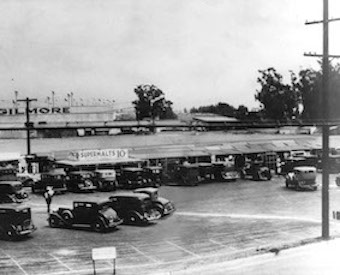 Not much is known about the Gilmores today, but in 1930, they was persuaded to rent a parcel of land so that Southern Californian farmers could bring abundant supplies of fresh fruits and vegetables to the locals. This was at a critical time during the Great Depression and the idea provided a positive solution for many people. Originally, just 12 farmers rolled up in their trucks along with 6 other merchants, each paid 50c rent per day. The venture soon expanded into the permanent fixture with over 100 outlets known as The Original Farmers Market, since 1934.
After meandering in labyrinthine passageways, eyeing the tasty treats at every turn, it’s time for an early lunch. Jody directs me to Magee’s Kitchen, purveyors of the lip-smacking corn beef sandwiches with spicy mustard on rye that fed the original farmers in the 1930’s. We also visit Magee’s House of Nuts, founded in 1917, and here since 1939. Today, Kanti fills the pots of 100 percent pure nuttiness in front of us from an industrial sized vintage blender with no nasty additives. My favourite is the smooth dry roasted peanut butter, but the almond, macadamia, walnut and pistachio butters are superb too.
In the 1950’s President Eisenhower, who was also a farmer, stopped by with plenty of questions about the blender. On a tour of America in the 1960’s the Beatles left signed photographs saying Magee’s was fab! Elvis Presley was another celebrity fan of the market and sadly, this is where James Dean enjoyed his last breakfast. More recently, Jennifer Aniston is a regular here.
Something for Everyone
Jody and I move on to sample pickles. Similar to a friendly bartender mixing exotic cocktails, Will at Kaylins & Kaylins conjures tasty plates of jalapeño, horseradish, mustard, spicy dill, kosher dill, and the original 1910 recipe sour pickles. These flavoursome treats are gluten free and vegan, it’s easy to guzzle an entire plate of them.
- Details
- Hits: 2661
January 2025
 John Paul Getty’s legacy is two outstanding museums in Los Angeles in honour of his prolific art collections. And, in the wake of the devastating wildfires, the Getty Foundation is leading the LA Fire Relief Fund for artists who have lost their livelihoods.
At the time of his death John Paul Getty (1892-1976) was known as the richest man in the world, worth around 25 billion dollars in today’s money. He had made his fortune in the oil fields of America and through a series of clever deals in Saudi Arabia, even learning Arabic to better negotiate the right to drill for oil there. His first shrewd investment of a $10,000 gift from his father in one lucky oil strike had made him a millionaire at 21.
After a couple of years enjoying the life of a Hollywood playboy, Getty knuckled down to a work ethic that would eventually alienate his family and friends. Notoriously parsimonious, he did his own washing in the hotel suites that doubled as his offices. Despite marrying five times and having five sons, he became an increasingly isolated, eccentric and lonely figure with several of his children and grandchildren suffering extreme physical and mental hardships.
The Getty Villa

Besides his family tragedies there were extraordinary triumphs, one being the Getty Villa set high beyond the bluffs in Pacific Palisades.The beating sun, warm sea breezes, aromatic plants, and Italian cedar trees all closely mimicking the Mediterranean so beloved by John Paul Getty. Joking that he was the reincarnation of a Roman emperor Getty instructed his architects to recreate the ancient Villa dei Papiri in Herculaneum, buried under tons of volcanic ash when Mount Vesuvius erupted in Naples, AD 79.
The Romanesque villa and its two Peristyle courtyards are lined with scores of lofty Corinthian columns, each crowned with the motif of acanthus leaves growing abundantly in four surrounding gardens. Both peristyles enclose long, glittering blue marble pools offering a place of peace and contemplation. Dripping grapevines heavy with fruit and foliage of resplendent colours adorn the shady trellises on either side of the longer outer peristyle. Classical statues grace the walkways running parallel with the smaller pool.
- Details
- Hits: 2246
October 2024
St Ives is a pretty coastal village in Cornwall with deep roots in the emergence of Marine Art, Troika Pottery and Cryséde Textiles.
St Ives Museum
 St Ives Museum started in 1926 on the founding principle of, “Gathering up the fragments lest they be lost.” This was at a time when the town was on the cusp of change; the fishing and mining industries were all but dying out. Decades of overfishing in Cornwall coupled with the closure of the tin mines meant the outflow of minerals into the sea which had once provided a rich food source for pilchards was no more.
The fishing season would begin in August with a cry across the town of Hevva! signalling that a shoal of silvery pilchards was in sight. The Seine net used to catch them was so vast (350m) that forty men were required to carry it down from the lofts to the big red boat waiting in the harbour to ‘shoot” it into the sea. Once caught the haul of pilchards was transferred into smaller tuck nets and taken to shore in boats called dippers.
It was the famous Victorian novelist and travel writer Wilkie Collins who introduced avid readers to the thrills of Cornish folklore in his Rambles Beyond Railways; Notes in Cornwall Taken A Foot, published in 1851. Collins, who was also a keen collector of statistics, records that in 1850 St Ives exported 22,000 barrels of pilchards, known as hogheads, each containing up to 3,000 fish.
With high demand from France and Spain, the pilchard trade was labour intensive demanding large numbers of the town’s population. Women and their eldest daughters, known as salt maidens, worked side by side to salt and stack layers of fish, up to four feet high, in twelve hour shifts for a few pence per hour. The salting process took around five weeks during which time the pilchards were pressed under great weights to extract their oil.
St Ives Museum was a pilchard packing factory in the 1840’s, and today retains a detailed history of the Cornish pilchard industry told through artefacts and visual stories. In 1847, the total exports from Cornwall was 122 million fish, which cause the storytellers to reflect on man’s greed, rather than man’s need. However, It is unlikely the hardworking townsfolk of St Ives could have envisaged that a part of their crowded, noisy and smelly workplace would be dedicated to preserving the stories of their rich cultural imprint.
Capturing the Light
 The Museum’s personable curator Andy Smith and his fact-toting deputy Peter Garrett are on a mission to tell the true story of St Ives’s transformation from a small fishing village into an internationally known artists colony. They are ably assisted by Cornish Art Historian and author David Tovey. A number of his superb personal collection of oil paintings make up the Museum’s current exhibition Capturing the Light 1885-1914. His book, Pioneers of St Ives Art at Home and Abroad 1889-1914 is a richly illustrated companion to it.
This is the second in a cycle of four exhibitions at St Ives Museum which documents the emergence and evolution of the colony as it has never been seen before. Far too often, the well-funded art establishments date its beginning to the mid-20th Century. But, as many of the glorious light infused paintings here demonstrate, its origins go further back in time.
Last years exhibition Discovering St Ives 1830-1890, won the Cornish Exhibition of the Year (small museum). This year, Capturing the Light celebrates the heyday of the marine artists who travelled from as far afield as Australia, Canada and America to paint the wonderfully wild scenery and magnificent light en plein air.
The arrival of the railways in 1877 had made access to rural areas easier. Turner’s visit to St Ives yielded preparatory sketches of the area, but no finished pieces. Whistler arrived in the spring of 1884 with the Camden Town Impressionist Walter Sickert, and the Australian born marine painter Mortimer Mempes in tow. Whistler produced several gentle oils of beach scenes from his vantage point above St Ives Bay.
But, it was the French painter Emile-Louis Vernier who put St Ives on the international art map. Inexorably drawn to the light, he completed around ninety paintings here between 1884-1887. When he returned to Paris with his paintings, two were exhibited at the Paris Salon. His poignant images of blue oceans and skies, red sailing boats, and calling lighthouses drew keen attention to the little fishing village.
- Details
- Hits: 4853
June 2024
If you are visiting the Royal Academy for the Summer Exhibition, you may as well enjoy Flaming June, the incandescent oil painting made by Lord Frederic Septimus Leighton in 1895.
A lithe woman sleeps in a dress of gloriously vivid saffron. Her form curls in a circular pose on a draped couch, one foot rests on the floor. Her ankle length hair falls in waves over her flushed youthful face. Behind her, sun rays shimmer over the Mediterranean and perhaps the strong scent of the overhanging oleander flowers have intoxicated her. A peaceful, yet powerful radiance emanates from her relaxed figure. A peep of a nipple, a long luscious thigh and a well rounded buttock all visible though her diaphanous slip.

The image of Flaming June as she drowses under a flower known for its toxic effects is perhaps a realisation of the connection between sleep and death. In any case, it can be viewed as an example of the Victorian preoccupation with the myth of Briar Rose, and other passive Sleeping Beauties in need of awakening. Whether one ascribes erotic, imaginative, literal or visual connotations to the subject, it is certain that Lord Leighton (1830-1896) blended the best of high renaissance art into his popular muse. She is Michelangelo’s Night made for the Medici chapel in Florence fused with the stylised flame haired females of the Pre-Raphaelites.
Like her creator, Flaming June has travelled far and wide. She was owned by the London Graphic magazine which put her on the cover of the 1895 Christmas edition. Then, after a ten year loan to the Ashmolean in Oxford in 1900, she disappeared for decades. She was eventually discovered concealed in a box behind a chimney in Battersea in1962 by a builder who sold her only for the value of her ornate frame.
A rumour persists that when he was a young man the avid pre-Raphaelite collector, music and theatre impresario Andrew Lloyd Webber spotted her in a Battersea junk shop for just £50. But his grandmother refused to loan him the money to purchase her.
For the last sixty years Flaming June has lived at the Museo de Arte de Ponce in Puerto Rico. She is part of the extensive European collection made by Luis A Ferre when Pre-Raphaelite art had fallen out of favour. After the major London galleries refused to purchase her, he whisked her off to the Caribbean in 1963 for a nominal sum.
Now, Flaming June has returned home, and is on loan to the Royal Academy from February 2023 where she will stay until January 2024. This is a happy homecoming for a work by Lord Leighton, the President of the Royal Academy for eighteen years from 1878.
When she was first exhibited publicly at the 1895 Royal Academy Summer Exhibition she caused a sensation. Her fiery presence prompted Samuel Courtauld to call the composition, “The most wonderful painting in existence.“ And, she has since become one of the most reproduced images in the world. One of the preparatory studies for the head of Flaming June was discovered at West Horlsey Place, the country house of the Duchess of Roxburghe, the great aunt of Bamber Gasgoine. The former host of University Challenge unexpectedly inherited the drawing in 2015, which had been hung discretely behind a bedroom door.
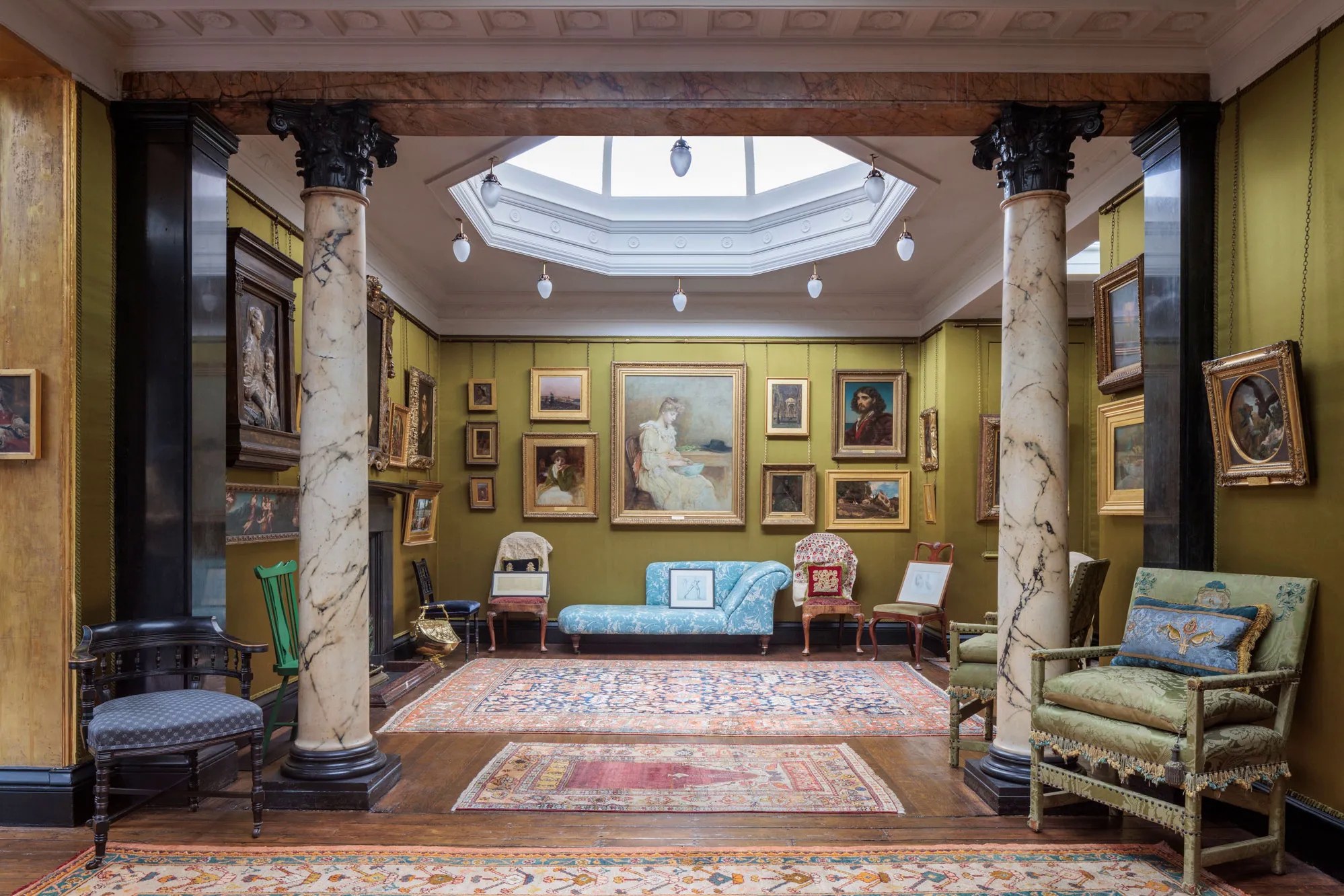

Today, most of Leighton’s exquisite drawings, paintings and fine sculptures are on permanent show at his studio and house museum at 12 Holland Park Road, a must visit. Leighton House in London is crammed with a lavish collection of richly coloured cermaic tiles and textiles gathered from his travels in North Africa and the Middle East. He followed in the footsteps of his close friend George Frederick Watts, the Symbolist painter, to his Little Holland House studio on nearby Melbury Road. Leighton assembled his awe-inspiring house over many years, where he lived alone. Eight other Royal Academicians were inspired by Watts and Leighton to build studio houses in the area, an artist’s colony known as the Holland Park Circle. Only Leighton’s house remains.
He made his first submission Cimabue to the Royal Academy Summer Exhibition in 1855.This epic painting, five metres long and two metres high, depicts a procession of the Madonna made by Leighton in Rome. On the first day of the exhibition Queen Victoria was persuaded by Prince Albert to buy it. From then on Leighton was considered the great hope for British art and he took full advantage of his opportunity to promote his maxim of, "Art for art sake" from within the establishment of the RA. Leighton died devoted to art and his last words expressed his love for the Academy, He lies in St Paul’s Cathedral next to the architect Sir Christopher Wren.
- Details
- Hits: 3097
August 29th, 2023
This year marks the 100 year anniversary of a prestigious poetry speaking contest at Oxford in which my grandmother Diana Homer was a prizewinning speaker.
 In the spring of 1923 the future Poet Laureate John Masefield made an announcement to The Times that he would be holding a verse speaking contest at Oxford. Masefield was an orphan sent away to sea at thirteen by an aunt who disapproved of his compulsive reading. A distressed seaman abroad and almost shipwrecked, he used his awe-inspiring voyages to inform much of his early writing, including Salt Water Ballads (1902) and Dauber (1913). Now, his plan was to discover a raft of beautiful speakers passionate about poetry to create a mainstream tradition for its performance.
As the principal organisers of the contest, John Masefield and his wife Constance sought help from their circle at Oxford. Gilbert Murray, the Regis Professor of Greek, George Gordon, a Professor of English Literature, Sir Herbert Warren, the President of Magdalen, and two winners of the Newdigate Prize: Laurence Binyon and Heathcote Garrod, a Professor of Poetry, all agreed to act as judges. George Gordon named the two day festival The Oxford Recitations, and gave the opening speech at The Examination Schools on July 26th 1923.
 Over five hundred contestants entered, exceeding all expectations. But, after hearing the first dozen or so speakers, Masefield wondered had he made a mistake in pushing for the contest, when a young woman began to speak in a way that made him hold his breath. He later recalled, “I had heard nothing like it. What I had not imagined was the power of such speech upon an audience, which sat as if in a trance.”
A recital by Diana Homer, the daughter of the Unitarian Minister F.A.Homer, would have a similar effect upon John Masefield. Diana was my grandmother, then a teenager drawn to Oxford with a headful of Chaucer, Shakespeare and Milton set by the judges as test poems in the syllabus, which had been mailed ahead of the competition. She would be a constant winner in the women’s division until 1929. More about that later.
On the whole, the first year of the Recitations revealed impressive talent and application. Each judge selected two favourites from amongst the trained speakers, talented amateurs, up and coming actors and students competing in the ballad, lyric, dramatic and narrative classes to battle it out in the Oxford Prize Class Finals. Highly coveted silver and bronze medals were awarded to the first and second place men and women with prizes of around £200 in today’s money for the exceptional speakers.
The contest took place at the Schools from morning until late in the evening. Door stewards ensured the recitals went undisturbed and prevented the audience from questioning the judges about their decisions, or from asking them for autographs. Clapping was restrained during the day in case exams were taking place elsewhere in the building. But, on Finals night, the crowd was roused into rip-roaring song, ending with a resounding, “Three cheers for Mr and Mrs Masefield!”
A Choir of Nightingales
John Masefield was guided by the revolutionary impules of WB Yeats, whose lecture in Lincoln’s Inn on new ways of speaking poetry he attended as a young man in 1901. Yeats’s methods, with his emphasis on the vowels and the beats, was a step towards realising the poet’s intention, but also a challenge to the stuffy Victorian drawing room approach to recitation. Masefield became a regular visitor to the Monday evening gatherings for poets, writers and painters held in what he described as, "the most interesting rooms in London" in which Yeats overwintered every year between 1895-1919.
By 1924, Masefield had resolved the earlier problems of his contestants shrieking, whispering, going prone or falling off the stage. A third day was added and most speakers were displaying the poems with their voices rather than outlandish gestures. He declared the effect of probably the best speakers in these islands gathered together was that of, “A choir of nightingales.” The excitement and delight of the poetry touched all present with a new feeling for poetry and a new understanding of the principle of speaking it